 Skip to content
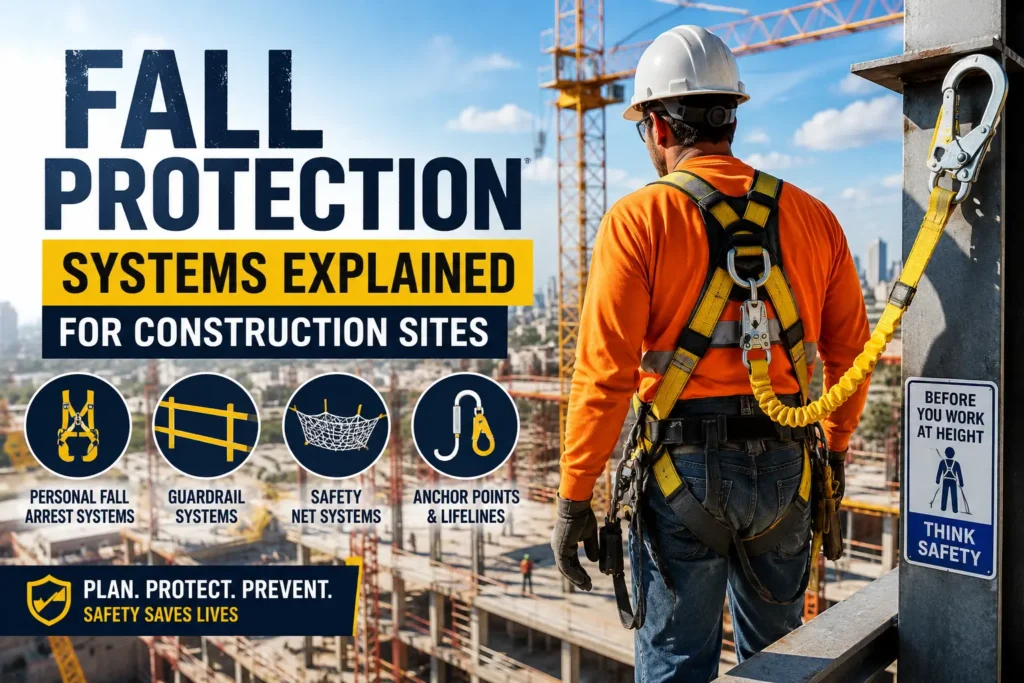
Fall Protection Systems Explained for Construction Sites
Falls are one of the leading causes of serious injuries and fatalities on construction sites. Every year, thousands of workers suffer accidents while working on roofs, scaffolds, ladders, steel structures, and elevated platforms. A single missing guardrail or improperly connected harness can turn a normal workday into a tragedy within seconds.
Recent construction safety statistics from Occupational Safety and Health Administration continue to show that falls remain the number one cause of construction deaths. According to OSHA’s latest fatality reports, falls account for more than one-third of all construction-related fatalities.
That is why understanding fall protection systems for construction sites is not just important for safety officers and supervisors. It is essential for every worker who steps onto an elevated work area. Proper fall protection saves lives, prevents costly project delays, and creates a stronger safety culture across the entire worksite.
Understanding Fall Hazards in Construction
Construction sites are constantly changing environments. Workers may be climbing scaffolding in the morning, installing roofing materials in the afternoon, and working near open edges before the day ends. Every change in elevation introduces new hazards that can lead to severe injuries or fatalities.
Falls happen quickly and often without warning. A worker may lose balance while carrying materials, step onto a weak surface, or slip during wet weather conditions. The danger increases because gravity does not allow time for correction once a fall begins.
Why Falls Are So Dangerous
The human body is not designed to absorb high-impact forces from sudden falls. Even a fall from a relatively low height can result in broken bones, spinal injuries, traumatic brain injuries, or death.
When workers fall from greater heights, the impact force increases dramatically. The body experiences enormous stress during sudden deceleration, especially if proper fall arrest systems are not in place.
Another serious issue is that falls often create secondary hazards. Workers may strike equipment, scaffolding, or structural components while falling. Tools and materials can also drop onto workers below, creating multiple casualties from a single incident.
Common Areas Where Falls Occur
Falls commonly occur in the following construction areas:
| Work Area | Common Fall Hazard |
|---|---|
| Roofs | Unprotected edges and skylights |
| Scaffolding | Missing guardrails or unstable platforms |
| Ladders | Improper usage or damaged ladders |
| Steel structures | Lack of tie-off points |
| Excavations | Falls into pits or trenches |
| Elevated platforms | Slippery or unstable surfaces |
Workers must understand that fall hazards are not limited to high-rise buildings. Even short-distance falls can become fatal under certain conditions.
What Is a Fall Protection System?
A fall protection system is a combination of equipment, procedures, and safety measures designed to prevent workers from falling or reduce injury severity if a fall occurs. These systems act like invisible safety shields protecting workers during elevated tasks.
Fall protection systems are not one-size-fits-all solutions. Different jobs require different types of protection depending on the work environment, height, structure design, and task complexity.
Purpose of Fall Protection Systems
The primary purpose of fall protection systems is to eliminate or control fall hazards before accidents occur. Effective systems either prevent falls entirely or safely stop workers before they strike lower levels.
A properly designed fall protection system also improves worker confidence. When workers know they are protected, they can focus more effectively on their tasks without unnecessary fear or hesitation.
Fall protection systems also help organizations comply with workplace safety regulations and reduce costly accident-related expenses.
OSHA Requirements for Fall Protection
According to OSHA regulations, fall protection is generally required in construction when workers are exposed to falls of 6 feet or more to lower levels.
OSHA standards require employers to:
- Identify fall hazards
- Provide proper fall protection systems
- Train workers adequately
- Inspect equipment regularly
- Implement rescue procedures
Failure to comply with these requirements can result in serious legal and financial consequences.
Types of Fall Protection Systems
Construction projects use different fall protection systems depending on site conditions and work activities.
Guardrail Systems
Guardrails are one of the simplest and most effective forms of fall prevention. They create physical barriers that prevent workers from reaching dangerous edges.
Guardrails are commonly installed around:
- Roof edges
- Scaffolding platforms
- Floor openings
- Elevated walkways
- Stair openings
A standard guardrail system typically includes:
- Top rail
- Mid rail
- Toe board
Guardrails are highly effective because they protect workers continuously without requiring active worker involvement.
Advantages of Guardrail Systems
- Provides passive protection
- Requires minimal worker action
- Reduces fall risks significantly
- Suitable for multiple workers simultaneously
Guardrails should always remain secure and properly maintained throughout the project.
Personal Fall Arrest Systems
A Personal Fall Arrest System (PFAS) is designed to stop a worker safely during a fall before they hit a lower level. This system does not prevent falls entirely but minimizes injury severity.
A PFAS usually includes:
- Full body harness
- Lanyard
- Shock absorber
- Lifeline
- Anchor point
Personal fall arrest systems are widely used in construction because they provide flexibility for workers moving across elevated areas.
How Personal Fall Arrest Systems Work
When a worker falls, the system absorbs and distributes fall forces across stronger parts of the body. The shock absorber reduces sudden impact forces while the anchor point holds the worker securely.
Without shock absorption, the sudden stopping force could cause severe internal injuries even if the worker survives the fall.
Safety Net Systems
Safety nets are installed below elevated work areas to catch workers or falling objects. They provide collective protection for multiple workers simultaneously.
Safety nets are commonly used during:
- Bridge construction
- High-rise building work
- Steel erection
- Roofing operations
Benefits of Safety Nets
- Protects multiple workers
- Reduces fatality risk
- Helps prevent dropped object injuries
- Allows greater worker mobility
Safety nets must be inspected regularly to ensure structural integrity.
Positioning Device Systems
Positioning systems allow workers to work hands-free while remaining supported on vertical surfaces such as towers or poles.
These systems are commonly used for:
- Steel erection
- Tower maintenance
- Pole climbing
- Structural welding
Workers remain connected while maintaining stable working positions.
Warning Line Systems
Warning lines are temporary barriers placed near roof edges to warn workers about fall hazards. These systems are often used during roofing activities.
Warning lines alone are usually not enough for high-risk areas. They are often combined with monitoring systems or additional fall protection methods.
Key Features
- Highly visible markers
- Restricted work zones
- Clear hazard boundaries
Workers should never cross warning lines without additional protection.
Controlled Access Zones
Controlled Access Zones (CAZ) limit worker access to high-risk areas where conventional fall protection may not be practical temporarily.
Only authorized and trained workers should enter these zones.
Controlled access systems are often used during:
- Leading edge work
- Precast concrete installation
- Certain roofing operations
Strict supervision is essential in these areas.
Travel Restraint Systems
Travel restraint systems prevent workers from physically reaching fall hazards. Unlike fall arrest systems, restraint systems stop workers before a fall can occur.
These systems are commonly used on rooftops and elevated platforms.
Advantages
- Prevents falls completely
- Reduces reliance on fall arrest
- Improves worker safety confidence
Travel restraint systems are often considered safer than fall arrest because no actual fall occurs.
Components of a Personal Fall Arrest System
Understanding each component of a PFAS is critical for proper usage and worker safety.
Full Body Harness
The full body harness distributes fall forces across the shoulders, chest, thighs, and pelvis. Modern harnesses are designed for comfort, mobility, and impact distribution.
Workers should inspect harnesses before every use for:
- Cuts
- Frayed stitching
- Damaged buckles
- Chemical damage
Improperly fitted harnesses can cause serious injuries during falls.
Lanyards and Shock Absorbers
Lanyards connect workers to anchor points. Shock absorbers reduce sudden stopping forces during falls.
There are several types of lanyards:
| Type | Purpose |
|---|---|
| Shock-absorbing lanyard | Reduces fall force |
| Self-retracting lifeline | Limits free-fall distance |
| Positioning lanyard | Supports hands-free work |
Damaged lanyards should never be reused.
Lifelines and Anchor Points
Anchor points are the foundation of every fall arrest system. If the anchor fails, the entire system fails.
Anchor points must be:
- Structurally sound
- Properly rated
- Installed by competent persons
- Inspected regularly
Workers should never connect to weak structures, pipes, or temporary fixtures.
How to Choose the Right Fall Protection System
Selecting the correct system depends on several factors.
Hazard Assessment
Before work begins, supervisors should evaluate:
- Height of work
- Surface stability
- Weather conditions
- Worker movement requirements
- Potential swing fall hazards
A detailed risk assessment helps determine the safest protection method.
Work Environment Considerations
Different environments require different systems. Roofing work may need warning lines and harnesses, while steel erection may require retractable lifelines and positioning systems.
The safest option is usually the system that eliminates fall exposure entirely.
Inspection and Maintenance of Fall Protection Equipment
Fall protection equipment must be inspected before every use and periodically by competent persons.
Inspection areas include:
- Harness stitching
- Buckles and connectors
- Lifeline integrity
- Anchor point condition
- Shock absorber status
Equipment exposed to falls should be removed from service immediately.
Poor maintenance can turn safety equipment into hidden hazards.
Training Requirements for Workers
Even the best fall protection systems become useless if workers do not understand how to use them correctly.
Training should cover:
- Hazard recognition
- Equipment usage
- Inspection procedures
- Emergency response
- Rescue planning
Refresher training is equally important because workers may forget procedures over time.
Practical demonstrations improve understanding better than classroom lectures alone.
Common Mistakes in Fall Protection
Many construction incidents happen because workers make avoidable mistakes.
Common mistakes include:
- Not wearing harnesses properly
- Using damaged equipment
- Connecting to weak anchor points
- Ignoring inspections
- Failing to calculate fall clearance
Overconfidence is another major danger. Experienced workers sometimes become careless due to familiarity with tasks.
Safety rules must apply equally to everyone regardless of experience.
Emergency Rescue Planning
A fall protection system without a rescue plan is incomplete. If a worker falls and remains suspended, suspension trauma can become fatal within minutes.
Rescue plans should include:
- Emergency contact procedures
- Rescue equipment availability
- Trained rescue teams
- First aid support
- Fast response systems
Every second matters during suspended fall emergencies.
Conclusion
Fall protection systems are among the most important safety measures on construction sites. They protect workers from one of the deadliest workplace hazards, falls from height. Whether using guardrails, harnesses, safety nets, or restraint systems, the goal remains the same: keeping workers alive and safe.
Understanding how fall protection systems work helps workers make smarter decisions while working at height. Safety is not only about equipment. It is about planning, training, inspections, communication, and responsibility.
Construction sites will always involve risks, but those risks become manageable when proper fall protection systems are selected, maintained, and used correctly. One properly connected harness, one inspected anchor point, or one installed guardrail can mean the difference between life and death.
How to Gain Experience as a Fresher Safety Officer
How to Handle Unsafe Work Situations on Site
Safety Planning Before Starting a Project
The Domino Effect of Unsafe Acts on Site
Fire Safety vs Industrial Safety: Which Career Is Better in 2026?
FAQs
1. What is the safest type of fall protection system?
Guardrail systems are often considered the safest because they provide passive protection without relying on worker action.
2. At what height is fall protection required in construction?
OSHA generally requires fall protection at heights of 6 feet or more in construction activities.
3. What are the main components of a personal fall arrest system?
The main components include a full body harness, lanyard, anchor point, and connecting device.
4. How often should fall protection equipment be inspected?
Equipment should be inspected before every use and periodically by qualified personnel.
5. Why is rescue planning important in fall protection?
Workers suspended after falls can experience suspension trauma quickly, making fast rescue procedures essential.
