 Skip to content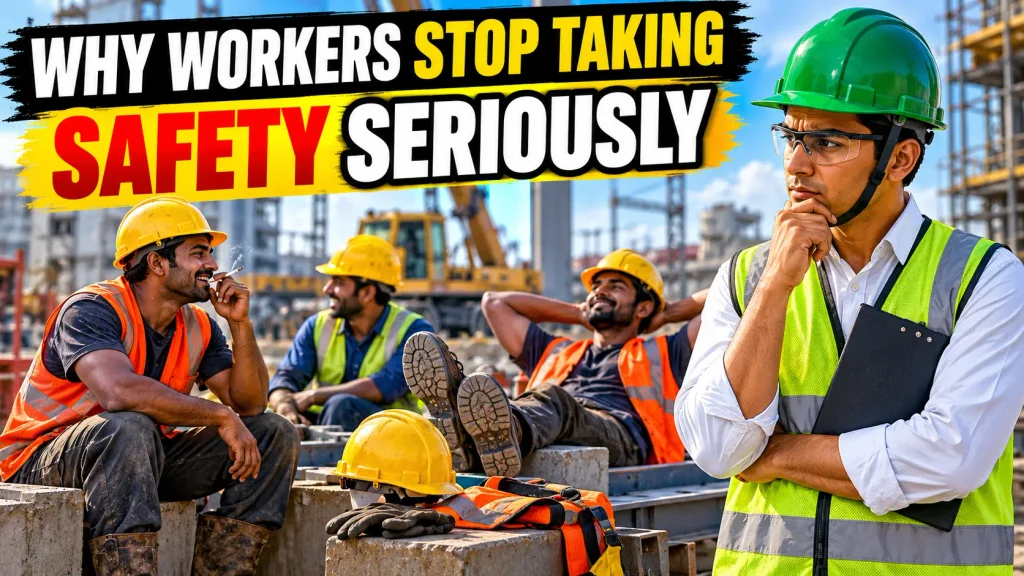
Why Workers Stop Taking Safety Seriously
Workplace safety is one of the most important responsibilities in construction, oil and gas, manufacturing, and other industrial sectors. Companies invest in safety training, personal protective equipment (PPE), toolbox talks, risk assessments, and safety inspections to prevent accidents. Yet, despite these efforts, some workers continue to ignore safety procedures, bypass protective measures, and take unnecessary risks while performing their daily tasks.
Why does this happen? Why do workers who understand the dangers of their jobs sometimes choose to work unsafely?
The answer is not always a lack of knowledge. In many cases, workers become careless because of routine, production pressure, weak supervision, ineffective safety training, or a workplace culture that treats safety as a formality. Understanding these reasons is essential for Safety Officers, HSE Engineers, supervisors, and management teams that want to improve safety performance.
What Does It Mean When Workers Stop Taking Safety Seriously?
Workers stop taking safety seriously when they begin treating safety requirements as unnecessary obstacles rather than essential measures for protecting themselves and others.
This behavior can develop gradually. A worker may initially follow every procedure, wear the required PPE, attend toolbox talks, and ask questions before starting a task. After several months of performing the same activity without experiencing an accident, the worker may begin to believe that certain precautions are no longer necessary.
For example, a worker who regularly works at height may decide to climb a ladder without securing it because the task will take only a few minutes. Another worker may remove safety glasses to complete a job more comfortably. A maintenance technician may skip an isolation verification because the equipment has been switched off many times before without any problems.
These decisions may appear harmless when nothing goes wrong. However, a single mistake can result in a serious injury or fatality.
The main concern is that unsafe behavior can become a normal part of daily work if nobody challenges it.
Why Do Workers Stop Taking Safety Seriously?
1. Repeating the Same Job Every Day
Routine is one of the most common reasons workers become less attentive to safety.
When workers perform the same activity every day, they gradually become familiar with the equipment, tools, and working environment. Experience is valuable, but excessive familiarity can create overconfidence.
A worker may start believing that experience alone is enough to prevent accidents. Instead of checking the work area, inspecting equipment, or following every step of the procedure, they begin relying on memory and habit.
Consider a scaffolder who has assembled hundreds of scaffolds. Because previous jobs were completed without an incident, the worker may become less careful when checking platforms, guardrails, access ladders, or scaffold stability.
The danger is that familiarity does not eliminate hazards. Site conditions change, equipment deteriorates, and unexpected situations can develop at any time.
How to prevent it: Safety Officers should encourage workers to reassess hazards before each task, even when the activity is familiar. Regular field observations, practical demonstrations, and discussions about changing site conditions can help workers remain alert.
2. Repeated Toolbox Talks Become Boring
Toolbox talks are intended to remind workers about hazards, safe working methods, and preventive measures. However, when the same information is repeated every day without meaningful discussion, workers may gradually lose interest.
Imagine attending a toolbox talk every morning where the Safety Officer reads the same points from a sheet. Workers listen for a few minutes, sign the attendance register, and return to work without understanding how the information applies to their tasks.
Over time, the toolbox talk becomes a routine administrative activity rather than a learning opportunity.
The problem is not necessarily the frequency of toolbox talks. The problem is how they are delivered.
How to prevent it: Make toolbox talks practical and relevant to the day’s work. Discuss actual site hazards, recent near misses, photographs of unsafe conditions, and examples of how accidents happen. Ask workers questions and encourage them to share their experiences.
A five-minute discussion that changes a worker’s behavior can be more valuable than a lengthy presentation that nobody remembers.
3. Production Pressure Takes Priority Over Safety
Construction and industrial projects operate under strict schedules. Managers must meet deadlines, equipment must remain productive, and contractors must complete assigned activities within the planned time.
Problems arise when workers believe that completing the job quickly is more important than completing it safely.
For example, a supervisor may pressure a worker to continue lifting operations even when the work area has not been properly barricaded. A team may rush excavation work without confirming underground utility locations because the project is behind schedule.
When such situations occur repeatedly, workers may conclude that following safety procedures is acceptable only when production is not affected.
This creates a dangerous workplace culture in which employees feel forced to choose between compliance and meeting expectations.
How to prevent it: Management must communicate that safety requirements apply even during urgent operations. Supervisors should plan work properly, provide sufficient resources, and avoid rewarding speed when it is achieved by ignoring essential controls.
Safety Officers should also raise concerns when unrealistic schedules create pressure to take unsafe shortcuts.
4. Nothing Bad Has Happened Before
One of the most dangerous beliefs in workplace safety is that a task must be safe because it has been completed many times without an accident.
This is a form of false confidence. Workers may see repeated success as evidence that safety precautions are unnecessary.
For example, a worker may climb onto an elevated platform without using the required fall protection because they have done it several times before. Another worker may operate machinery with a damaged guard because no injury has occurred during previous shifts.
The absence of an accident does not prove that a task is safe. It may simply mean that the hazardous conditions have not yet resulted in harm.
A near miss can also create a false sense of security if workers treat it as a lucky escape instead of a warning.
How to prevent it: Use near misses, safety observations, and incident case studies to demonstrate how small deviations can lead to serious consequences. Encourage workers to report unsafe conditions even when nobody has been injured.
5. Safety Rules Are Enforced Inconsistently
Workers pay attention not only to what a company says about safety but also to what supervisors and managers actually do.
If one worker is stopped for failing to wear a hard hat while another is allowed to continue working without one, employees may believe that safety rules depend on who is involved.
Similarly, if supervisors regularly bypass permit requirements but expect workers to follow every rule, the message becomes contradictory.
Inconsistent enforcement weakens trust in the safety system. Some workers may begin to view safety rules as optional rather than mandatory.
How to prevent it: Apply safety requirements consistently across all levels of the organization. Managers, engineers, supervisors, contractors, and workers should demonstrate the same commitment to safe working practices.
Fair enforcement, clear explanations, and appropriate corrective action help establish credibility.
6. Workers Do Not Understand the Real Risks
Some workers follow instructions without fully understanding why particular precautions are necessary.
They may know that they must wear a particular type of PPE or follow a specific procedure, but they may not understand the consequences of ignoring it.
For example, a worker may wear a face shield during grinding because the Safety Officer instructed them to do so. However, if they do not understand the risk of flying particles and eye or facial injuries, they may remove the shield when nobody is watching.
Similarly, workers involved in confined space activities may underestimate the danger of oxygen deficiency or toxic gases if they have not received effective training.
Instructions alone do not always create understanding.
How to prevent it: Explain the hazard, the possible consequences, and the reason behind each control measure. Demonstrations, practical exercises, and real incident examples help workers connect safety requirements with the risks they face.
7. Poor Supervision on the Worksite
Supervisors have a direct influence on how workers perform their tasks. When supervision is weak, unsafe behavior can continue without correction.
A supervisor who focuses exclusively on production may overlook unsafe lifting practices, poor housekeeping, improper use of tools, or unauthorized changes to work procedures.
Workers may gradually recognize that nobody checks compliance regularly. Once this happens, they may become less motivated to follow safety requirements.
However, supervision should not mean watching every worker constantly. It means ensuring that activities are properly planned, hazards are controlled, and workers receive appropriate guidance.
How to prevent it: Train supervisors to recognize hazards, conduct pre-task briefings, monitor critical activities, and intervene when unsafe conditions arise. Safety responsibilities should be clearly defined rather than left entirely to the Safety Officer.
8. Workers Feel That Safety Is Only About Paperwork
In some workplaces, safety is measured mainly through completed forms, attendance sheets, inspection reports, and signed permits.
Documentation is important because it provides evidence of planning, communication, and compliance. However, paperwork alone cannot guarantee that work is being performed safely.
A permit may be signed correctly while the actual work area remains unsafe. A risk assessment may identify all relevant hazards, but workers may never receive a proper briefing about the required controls.
When employees see a gap between documented procedures and actual site conditions, they may lose confidence in the safety process.
How to prevent it: Verify that safety arrangements are implemented in the field. Check whether workers understand the risk assessment, whether permit conditions are being followed, and whether required control measures remain effective throughout the task.
The objective is not simply to complete safety documentation. It is to make sure the controls work in practice.
9. Workers Are Afraid of Reporting Problems
A healthy safety culture encourages employees to report hazards, near misses, mistakes, and unsafe conditions.
Unfortunately, some workers fear being blamed, punished, humiliated, or held responsible for delays when they raise concerns.
As a result, they may remain silent when they notice a dangerous condition. Others may avoid reporting near misses because they believe that reporting will create unnecessary trouble.
When problems remain hidden, management loses opportunities to correct them before an accident occurs.
Over time, workers may also stop participating in safety discussions because they believe their concerns will not be taken seriously.
How to prevent it: Encourage open reporting and respond constructively to genuine safety concerns. Distinguish between honest mistakes, system weaknesses, and deliberate or reckless violations. Workers should be able to raise concerns without fear of unfair treatment.
10. Lack of Recognition for Safe Behavior
Workers often receive attention when they violate a safety rule, but their positive behavior may go unnoticed.
For example, a worker who identifies a damaged lifting sling before an operation begins may prevent a serious incident. Another worker may stop a colleague from entering an unsafe area.
If these actions are never acknowledged, employees may feel that their efforts make little difference.
Recognition is not a substitute for safe working conditions, proper training, or effective supervision. Nevertheless, genuine appreciation can reinforce the importance of positive safety behavior.
How to prevent it: Recognize workers who report hazards, suggest practical improvements, follow critical procedures, and help colleagues work safely. Recognition can be as simple as thanking someone during a toolbox talk or explaining how their observation prevented a potential incident.
11. Uncomfortable or Unsuitable PPE
Workers are less likely to use PPE correctly when it is uncomfortable, damaged, poorly fitted, or unsuitable for the task.
For example, safety glasses that fog up can interfere with visibility. Gloves that do not fit properly may make handling tools difficult. Poorly selected respiratory protection may create discomfort or fail to provide the required protection.
In such situations, workers may remove their PPE, adjust it incorrectly, or replace it with equipment that offers insufficient protection.
This does not mean workers should decide independently which PPE to use. It means employers must consider usability alongside the level of protection required.
How to prevent it: Select suitable PPE through proper hazard assessment, provide the correct sizes, maintain equipment, and train workers in its proper use. Investigate complaints about discomfort and identify safe alternatives where possible.
12. Fatigue and Long Working Hours
Physical and mental fatigue can affect attention, reaction time, judgment, and decision-making.
Workers who complete long shifts, work consecutive night shifts, or perform physically demanding activities may struggle to remain alert throughout the working day.
A fatigued worker may forget an important step, overlook a hazard, misunderstand an instruction, or make an incorrect decision while operating equipment.
The situation can become more dangerous when fatigue is combined with heat stress, dehydration, repetitive tasks, or production pressure.
How to prevent it: Manage working hours, provide appropriate rest breaks, monitor signs of fatigue, and ensure that staffing arrangements do not encourage workers to continue when they are unfit for duty.
Safety Officers should treat fatigue as a potential workplace risk rather than assuming that every mistake is caused by carelessness.
13. Workers Copy Unsafe Behavior From Others
People often learn workplace behavior by observing their colleagues and supervisors.
If experienced workers routinely ignore safety precautions, new employees may assume that those practices are acceptable.
For example, a new worker may notice that senior employees regularly climb onto equipment without using designated access points. Even if formal training explains the correct procedure, the worker may copy the behavior they see every day.
This is particularly concerning when unsafe practices become part of the unofficial way work is performed.
How to prevent it: Ensure that experienced workers demonstrate safe practices and understand their influence on others. Supervisors should challenge unsafe habits early and provide positive examples of how work should be performed.
14. Safety Training Does Not Change Workplace Behavior
Attending training does not automatically mean that a worker can apply the information correctly.
Some training programs focus heavily on presentations, written tests, and certificates without providing enough practical experience.
Workers may remember the basic theory but struggle to identify hazards or apply control measures during actual work.
For example, a worker may understand the definition of working at height but fail to inspect the access equipment or recognize an unsafe platform during a site activity.
Effective training must bridge the gap between knowing the rules and following them in real situations.
How to prevent it: Combine classroom instruction with practical demonstrations, workplace coaching, competency assessments, and periodic refresher training. Observe workers performing the task to verify that they can apply what they have learned.
15. Management Does Not Lead by Example
Workers quickly notice when management’s actions contradict its safety messages.
If managers demand strict compliance but ignore hazards when project deadlines are approaching, employees may conclude that safety is a secondary priority.
For example, management may promote a zero-accident campaign while refusing to provide suitable equipment or sufficient time to complete high-risk activities safely.
Such contradictions can damage the credibility of the entire safety program.
How to prevent it: Senior management should demonstrate visible commitment by providing resources, supporting stop-work decisions, addressing reported hazards, and including safety in operational planning.
A strong safety culture develops when leadership decisions consistently support the organization’s stated safety expectations.
Warning Signs That Workers Are No Longer Taking Safety Seriously
Safety Officers and supervisors should recognize early signs of declining safety engagement before they contribute to an incident.
Common warning signs include:
- Workers repeatedly using PPE incorrectly or removing it during tasks.
- Employees signing toolbox talk attendance sheets without participating.
- Repeated violations of the same safety procedures.
- Workers bypassing permit conditions or isolation requirements.
- Increasing numbers of unsafe acts and unsafe conditions.
- Near misses going unreported.
- Workers ignoring damaged tools or equipment.
- Supervisors accepting shortcuts to save time.
- Employees showing little interest in safety briefings.
- Workers becoming defensive when hazards are discussed.
One warning sign alone does not necessarily indicate a poor safety culture. However, repeated patterns should prompt a closer examination of working conditions, supervision, training, and management practices.
What Should a Safety Officer Do When Workers Ignore Safety Rules?
A professional Safety Officer should investigate the reasons behind unsafe behavior instead of immediately assuming that workers are careless or irresponsible.
Step 1: Stop the Activity if There Is Immediate Danger
If a worker’s actions create an immediate risk of serious injury, intervene promptly and arrange for the activity to be stopped or made safe in accordance with site procedures.
For example, if a worker is performing work at height without the required fall protection, ensure that the activity stops until appropriate controls are established.
The priority is to prevent harm.
Step 2: Understand Why the Worker Is Taking the Risk
Once the immediate danger has been controlled, speak with the worker and ask why the procedure was not followed.
Possible reasons include inadequate training, unsuitable equipment, unclear instructions, production pressure, fatigue, or deliberate disregard of requirements.
Listen carefully before deciding on corrective action. The explanation may reveal a wider problem affecting several workers.
Step 3: Explain the Hazard and Consequences
Explain the specific risk associated with the unsafe action and how the required control prevents harm.
Avoid relying only on statements such as “This is against safety rules.” Help the worker understand why the rule exists and what could happen if the hazard is not controlled.
A clear explanation can be more effective than repeated warnings.
Step 4: Correct the Workplace Conditions
If the problem involves defective equipment, inadequate access, insufficient resources, or unrealistic work planning, coordinate with the responsible department to correct it.
Workers cannot consistently follow a safe procedure when essential equipment or suitable working arrangements are unavailable.
Step 5: Monitor Whether the Problem Repeats
Follow up after corrective action has been taken. Check whether the worker follows the procedure and whether similar behavior occurs elsewhere on site.
If deliberate or repeated violations continue despite adequate training, suitable equipment, and clear instructions, apply the organization’s established disciplinary process fairly and consistently.
The aim is to prevent recurrence, not simply to record the violation.
How Management Can Build a Workplace Where Safety Matters
Changing unsafe behavior requires more than reminders from the Safety Department. Management must create working conditions in which safe behavior is practical, expected, and supported.
Make Safety Part of Daily Work Planning
Identify hazards before work begins, coordinate activities between contractors, and ensure that workers understand the required controls.
Proper planning reduces the likelihood that employees will feel forced to improvise or take shortcuts.
Encourage Worker Participation
Involve workers in risk assessments, toolbox talks, inspections, and incident investigations where appropriate.
Employees who contribute their experience and ideas are more likely to understand and support safety improvements.
Measure Safety Beyond Accident Statistics
A low accident rate does not automatically prove that a workplace is safe. Serious hazards may remain uncontrolled, and near misses may go unreported.
Management should also evaluate leading indicators, such as the quality of inspections, closure of corrective actions, hazard reporting, competency assessments, and the effectiveness of critical safety controls.
Create Accountability at Every Level
Safety responsibilities should be clearly assigned to management, engineers, supervisors, contractors, and workers.
The Safety Officer should provide guidance, monitor compliance, and raise concerns, but operational managers and supervisors must also take responsibility for ensuring that work is properly planned and controlled.
Respond to Safety Concerns Promptly
When workers report a hazard, management should investigate it and communicate the action taken.
If employees repeatedly report the same problem without seeing any improvement, they may stop reporting it. Prompt responses demonstrate that their participation has value.
Is It Always the Worker’s Fault When Safety Rules Are Ignored?
No. Unsafe behavior can be influenced by individual decisions, but it may also reveal weaknesses in the organization’s safety management system.
For example, a worker who repeatedly removes unsuitable gloves may need a better-fitting alternative. A team that regularly bypasses a procedure may be responding to poor work planning or equipment limitations. A worker who misses a critical step because of fatigue may need appropriate working hours and rest arrangements.
This does not mean that workers have no responsibility for their actions. Employees must follow applicable procedures, use equipment correctly, and report hazards.
However, effective incident prevention requires organizations to examine both individual behavior and the conditions that influence it.
Blaming workers without addressing underlying problems can leave the real causes of unsafe behavior unchanged.
Conclusion
Workers rarely stop taking safety seriously for just one reason. Repetitive work, production pressure, weak supervision, ineffective training, unsuitable PPE, fatigue, and inconsistent management decisions can all contribute to declining safety awareness.
The solution is not to conduct more toolbox talks or issue more warnings without examining whether existing measures are effective. Organizations must understand why unsafe behavior occurs and address the factors that encourage it.
For Safety Officers and HSE Engineers, the most important lesson is to look beyond the unsafe act and investigate the conditions behind it. Speak with workers, involve supervisors, verify safety controls, and work with management to make safe behavior achievable every day.
A strong safety culture develops when workers understand the risks, management supports safe decisions, supervisors lead by example, and everyone takes responsibility for preventing harm.
Ultimately, the goal is not to make workers afraid of breaking safety rules. It is to create a workplace where they understand the value of those rules and choose to follow them, even when nobody is watching.
What Is the Difference Between a Safety Officer and an HSE Engineer?
