 Skip to content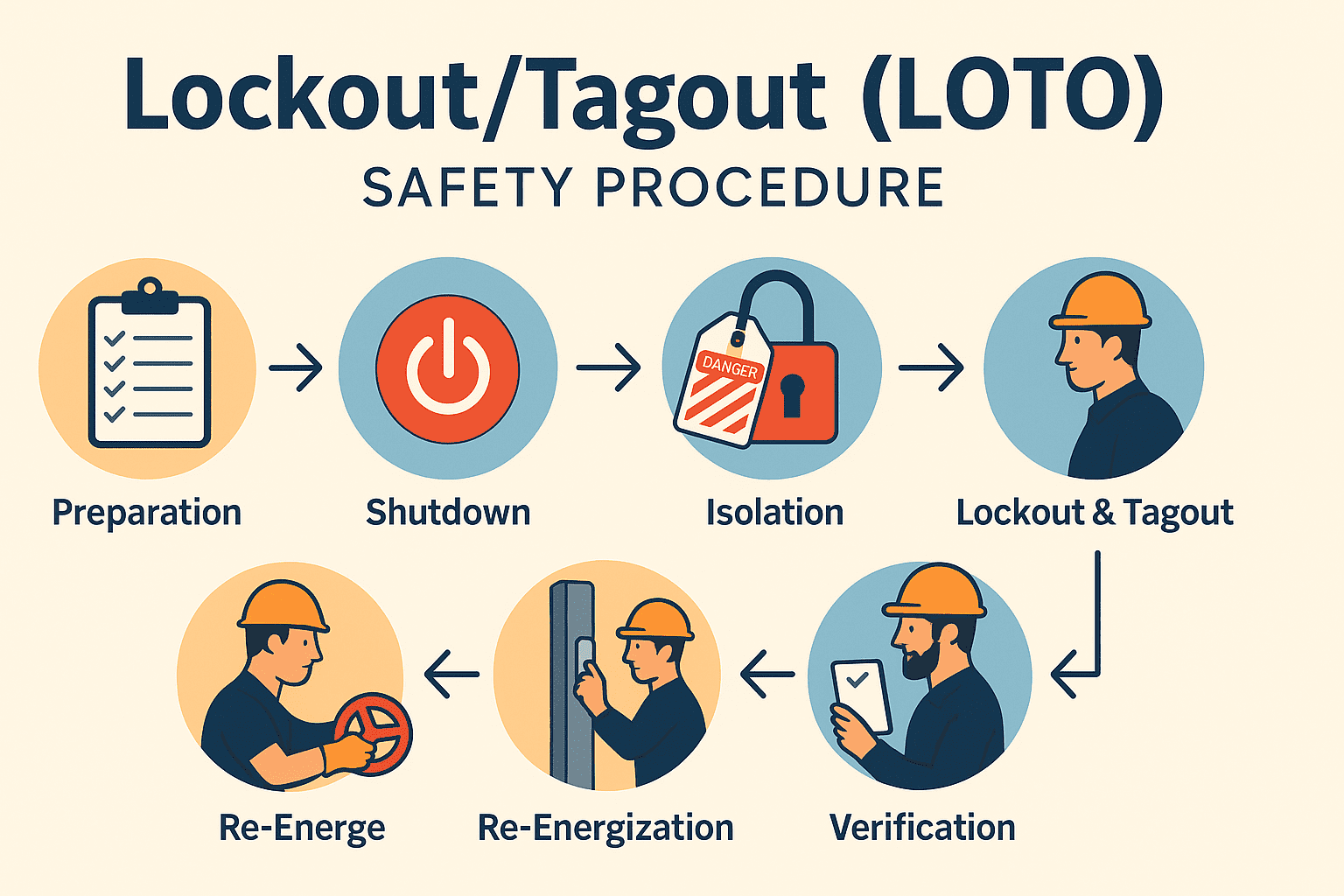
Lockout and Tagout – LOTO Safety Procedure
1. Introduction
Every year, thousands of workers suffer injuries due to the unexpected start-up of machines or release of stored energy. The Lockout/Tagout (LOTO) safety procedure is a critical process that ensures hazardous energy is properly isolated before maintenance or servicing tasks are performed. Implementing a robust LOTO program not only ensures compliance with OSHA Standard 29 CFR 1910.147 but also protects lives.
2. What is Lockout/Tagout (LOTO)?
Lockout/Tagout is a safety practice used to prevent accidental or unauthorized operation of machinery during maintenance.
- Lockout: Physically locking energy isolation devices (valves, breakers, switches) using a padlock.
- Tagout: Attaching a warning tag to indicate that equipment must not be operated until the tag is removed by the authorized person.
3. Why LOTO is Important
- Prevents Fatalities: OSHA estimates that LOTO prevents around 120 fatalities annually.
- Reduces Injuries: Over 50,000 injuries could be avoided each year with proper LOTO compliance.
- Legal Compliance: Non-compliance can lead to heavy OSHA fines.
- Protects Equipment: Prevents mechanical damage during unexpected startup.
Example:
A maintenance worker was servicing a conveyor belt when a colleague unknowingly switched it on. Without LOTO, the worker’s arm was caught, leading to severe injury. Proper lockout would have prevented this.
4. When LOTO is Required
LOTO must be applied whenever there is:
- Maintenance or servicing of equipment.
- Cleaning, unjamming, or adjusting machinery.
- Repair or replacement of electrical, mechanical, hydraulic, pneumatic, or thermal systems.
- Any work where unexpected start-up could cause injury.
5. Step-by-Step Lockout/Tagout Procedure
Step 1: Preparation
- Identify the equipment and all energy sources (electrical, hydraulic, pneumatic, thermal, gravitational).
- Review machine-specific LOTO procedures.
Step 2: Notification
- Inform all affected employees that the equipment will be locked out.
Step 3: Shutdown
- Power down the machine according to the manufacturer’s instructions.
Step 4: Isolation
- Disconnect or isolate all energy sources (switches, valves, circuit breakers).
Step 5: Lockout & Tagout
- Apply lockout devices and attach tags with authorized personnel details.
Step 6: Release Stored Energy
- Bleed off hydraulic pressure, discharge capacitors, release springs.
Step 7: Verification
- Test the equipment to ensure it cannot operate. Return controls to the “OFF” position.
Step 8: Perform Maintenance
- Carry out the required work safely.
Step 9: Re-Energization
- Remove tools, reassemble guards, and ensure all personnel are clear.
- Remove locks and tags in reverse order, restoring energy sources.
6. LOTO Devices and Tools
- Padlocks (color-coded for departments)
- Lockout hasps
- Circuit breaker lockouts
- Valve lockouts
- Cable lockouts
- Safety tags with warning messages
7. Common Mistakes to Avoid
- Using only tags without locks.
- Sharing a single lock for multiple workers.
- Failing to verify energy isolation.
- Not having machine-specific LOTO procedures.
8. LOTO Compliance Checklist
Below is a Machine Lockout/Tagout Inspection Checklist you can use:
| Item | Check | Yes/No | Remarks |
|---|---|---|---|
| Have all energy sources been identified? | |||
| Is equipment shut down properly? | |||
| Are all energy isolating devices locked and tagged? | |||
| Has stored energy been released? | |||
| Is verification of isolation completed? | |||
| Are locks and tags identifiable with authorized person’s details? | |||
| Are tags securely attached and readable? | |||
| Is re-energization done only after all personnel are clear? | |||
| Are all lockout devices in good condition? |
9. Training & Responsibilities
- Authorized Employees: Apply and remove LOTO devices.
- Affected Employees: Understand purpose and impact of LOTO.
- Other Employees: Stay clear of locked/tagged equipment.
Regular LOTO training should be conducted annually or whenever new equipment is introduced.
10. Best Practices for Effective LOTO Implementation
- Maintain a written LOTO policy.
- Use color-coded locks for easy identification.
- Conduct periodic LOTO audits.
- Ensure all LOTO devices are standardized across the workplace.
- Keep spare locks and tags in accessible locations.
11. Conclusion
LOTO is more than just a compliance requirement—it’s a life-saving procedure. By following the step-by-step process, providing training, and using the right equipment, workplaces can dramatically reduce the risk of injury or death.
12. Download Free LOTO Checklist
📥 Download Lockout/Tagout Compliance Checklist (PDF) (OSHA Official Guide)
How to Perform a Fire Risk Assessment in the Workplace – Step-by-Step Guide
How to Conduct a Dynamic Risk Assessment in Real-Time Work Environments
Machine Safety Inspection Checklist | Free Template Download
Electrical Safety Inspection Checklist | Free Downloadable Template
