 Skip to content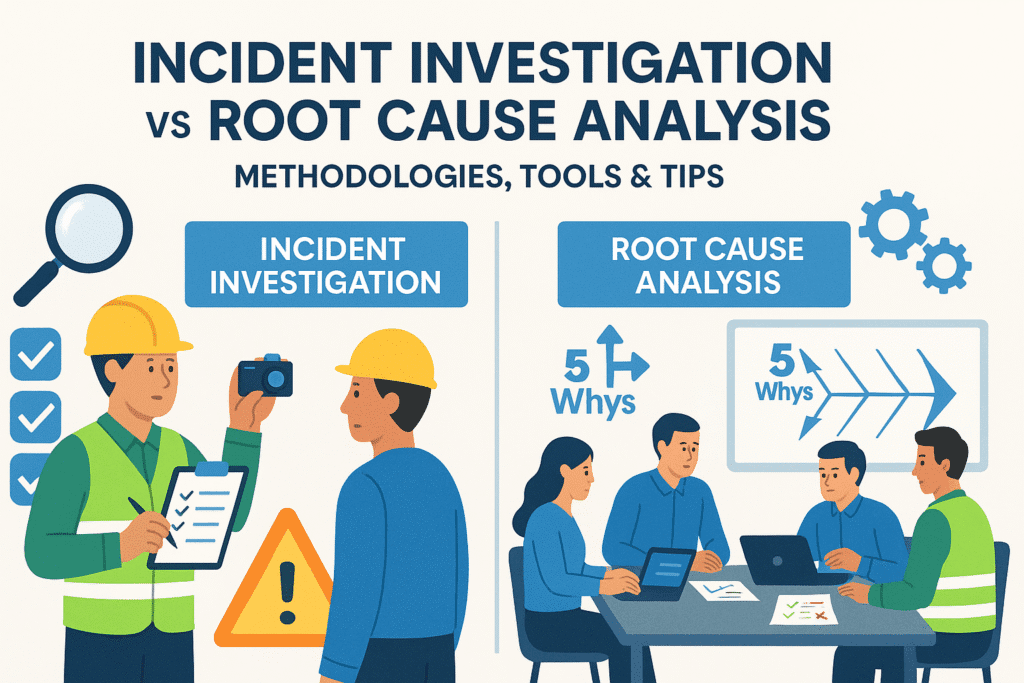
Incident Investigation vs Root Cause Analysis: Methodologies, Tools & Tips
When an incident occurs in the workplace—whether a near miss, injury, or equipment failure—organizations must respond effectively. Two key processes often mentioned together are incident investigation and root cause analysis (RCA). While related, they are not the same. Understanding their differences, methodologies, and tools is essential to prevent recurrence and improve safety performance. This article explains Incident Investigation vs Root Cause Analysis, outlines common methodologies, and offers practical tools and tips for safety professionals.
What Is Incident Investigation?
An incident investigation is a structured process to collect and analyze information about an incident to understand what happened. It focuses on facts, sequence of events, and immediate causes.
Key Goals:
- Determine the who, what, when, where, and how of the incident
- Document evidence, witness statements, and conditions
- Identify contributing factors and immediate causes
- Recommend corrective actions to prevent recurrence
Example: After a slip-and-fall accident, the safety team interviews witnesses, photographs the area, and reviews cleaning schedules to determine what led to the hazard.
What Is Root Cause Analysis (RCA)?
Root Cause Analysis goes deeper than incident investigation. It’s a systematic approach to identify the underlying causes of an incident—those that, if eliminated, would prevent recurrence.
Key Goals:
- Look beyond immediate causes to systemic issues
- Ask “why” multiple times to uncover hidden factors
- Provide long-term, sustainable corrective actions
Example: The same slip-and-fall accident’s RCA reveals that poor training on spill response and lack of non-slip mats contributed to the hazard—issues not obvious at first glance.
Incident Investigation vs Root Cause Analysis: Key Differences
| Aspect | Incident Investigation | Root Cause Analysis |
|---|---|---|
| Focus | What happened | Why it happened (underlying causes) |
| Depth | Immediate & contributing factors | Systemic and latent factors |
| Outcome | Factual report, corrective actions | Long-term solutions, prevention strategies |
| Timing | Conducted immediately after the incident | Conducted after initial investigation data is gathered |
| Tools Used | Interviews, photos, checklists, timelines | 5 Whys, Fishbone Diagram, Fault Tree, TapRooT® |
Methodologies for Incident Investigation
- Initial Response and Scene Control – Ensure safety, secure the area, and preserve evidence.
- Data Collection – Interviews, witness statements, photographs, equipment logs.
- Timeline Reconstruction – Map the sequence of events leading up to the incident.
- Identification of Immediate Causes – Unsafe acts, unsafe conditions, or failures that directly triggered the incident.
- Preliminary Recommendations – Quick fixes to prevent further harm (e.g., cordoning off area, temporary repairs).
Methodologies for Root Cause Analysis
- Gather Investigation Data – Use the information collected during the incident investigation.
- Identify Contributing Factors – Organize data into categories (human, equipment, environment, procedures).
- Apply RCA Tools –
- 5 Whys: Repeatedly ask “why” until reaching the root cause.
- Fishbone (Ishikawa) Diagram: Categorize potential causes under headings like People, Process, Equipment, Environment.
- Fault Tree Analysis (FTA): Start from the top event and work backward to underlying failures.
- TapRooT® or Cause Mapping: Structured methods to link evidence to root causes.
- Develop Corrective and Preventive Actions (CAPA) – Target the root cause, not just the symptoms.
- Verify Effectiveness – Monitor implementation and outcomes to ensure the issue is resolved.
Tools for Both Processes
- Incident Investigation Checklists – Ensure consistent data collection.
- Interview Templates – Standardize witness questioning.
- Root Cause Analysis Software – Digitally map causes and corrective actions.
- Action Tracking Systems – Assign responsibilities and monitor closure of recommendations.
- Lessons Learned Databases – Share findings across the organization to prevent recurrence elsewhere.
Tips for Effective Incident Investigation and RCA
- Act quickly but thoroughly – Collect evidence before it’s lost but avoid rushing analysis.
- Maintain objectivity – Focus on systems, not blame.
- Involve multidisciplinary teams – Safety, operations, maintenance, and frontline staff bring different perspectives.
- Communicate findings clearly – Use visuals, flowcharts, and plain language.
- Integrate into continuous improvement – Feed lessons learned back into training, risk assessments, and audits.
Conclusion
Incident Investigation and Root Cause Analysis are complementary processes. Investigation identifies what happened and immediate causes; RCA digs deeper to reveal systemic issues. Together, they form a powerful approach to learning from incidents, preventing recurrence, and strengthening workplace safety. By applying structured methodologies, using effective tools, and following best practices, safety professionals can turn incidents into opportunities for lasting improvement.
External Link: OSHA Incident Investigation Guide (https://www.osha.gov/incident-investigation)
Emergency Response Plans: What Every Facility Should Include (and Often Misses)
Behavior Based Safety Programs: How to Design, Implement, and Sustain for Workplace Excellence
Change Management in Safety: Introducing New Procedures Without Resistance
Contractor Safety Management: Aligning External Contractors with Your Safety System
Incident Investigation Report Template – Free Download
Exam-Oriented Practice Questions with Answers
Short Answer Questions
- What is the main difference between incident investigation and root cause analysis?
Answer: Incident investigation identifies what happened and immediate causes, while root cause analysis digs deeper to uncover underlying systemic causes. - List two tools used for root cause analysis.
Answer: (i) 5 Whys Technique; (ii) Fishbone (Ishikawa) Diagram. - Why is it important to conduct an incident investigation promptly?
Answer: To secure evidence, collect accurate witness statements, and prevent further harm.
Long Answer Questions
- Explain the steps of an effective incident investigation.
Answer: Secure the scene, collect data (witness statements, photos, logs), reconstruct the timeline, identify immediate causes, and issue preliminary recommendations to prevent recurrence. - Describe how to perform a root cause analysis after an incident.
Answer: Gather investigation data, identify contributing factors, apply RCA tools (5 Whys, Fishbone, FTA), develop corrective actions targeting root causes, and verify their effectiveness over time. - Discuss the benefits of integrating incident investigation and root cause analysis into a single process.
Answer: It ensures a seamless transition from immediate fact-finding to deeper analysis, leading to comprehensive corrective actions, reduced recurrence, improved safety culture, and organizational learning.
Scenario-Based Questions
- A worker suffers a minor injury from a machine. The investigation blames operator error. What’s your next step?
Answer: Conduct a root cause analysis to explore underlying issues (training gaps, machine guarding, procedures) rather than stopping at operator error. - During an RCA, your team identifies multiple potential root causes. How do you prioritize them?
Answer: Assess each cause for impact and likelihood, focus on those that, if eliminated, would most effectively prevent recurrence, and develop corrective actions accordingly. - Your investigation found poor housekeeping caused a slip, but RCA reveals inadequate inspection schedules. What corrective actions should you take?
Answer: Implement a revised inspection and cleaning schedule, assign responsibilities, train staff, and monitor effectiveness to ensure sustainable improvement.
