 Skip to content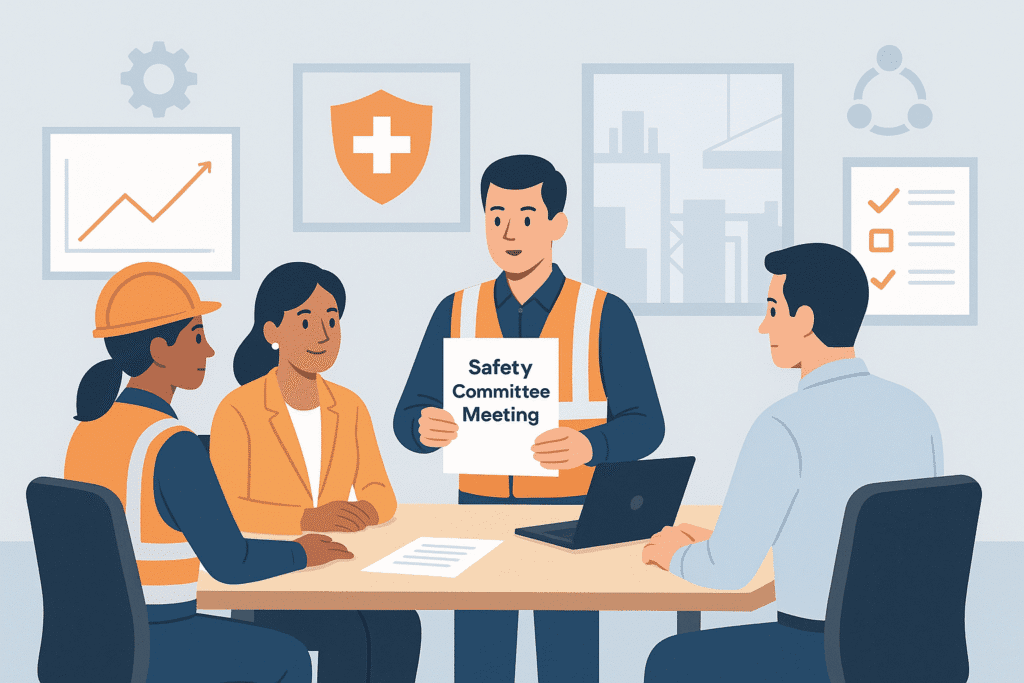
Safety Committee Formation and Functioning in the Workplace
A strong safety culture in any organization depends on employee participation, communication, and shared accountability. One of the most effective ways to achieve this is by establishing a Safety Committee.
A Safety Committee brings together management and workers to identify risks, review incidents, and promote proactive safety measures. It ensures that everyone—from senior management to site workers—plays an active role in maintaining a safe and healthy workplace.
For authoritative guidance on integrating worker participation and safety committee practices into an effective workplace safety program, refer to the OSHA Recommended Practices for Safety and Health Programs, which outlines foundational elements including leadership, worker involvement, hazard controls, communication, and continuous improvement.
This guide explains everything you need to know about forming, managing, and sustaining an effective Safety Committee in your organization.
What is a Safety Committee?
A Safety Committee is a group of management and employee representatives who meet regularly to discuss and improve workplace health, safety, and welfare.
Definition:
A Safety Committee is a joint group formed within an organization to plan, review, and promote safe work practices through consultation and cooperation between management and workers.
The committee acts as a bridge between employees and management to ensure that safety policies are not just created but also implemented and monitored effectively.
Purpose of a Safety Committee
The primary purpose of forming a safety committee is to facilitate communication, cooperation, and collaboration in addressing workplace safety and health issues.
Objectives include:
- Promoting awareness of health and safety among employees.
- Reviewing incidents, near-misses, and unsafe conditions.
- Identifying and correcting workplace hazards.
- Recommending improvements to safety systems and procedures.
- Ensuring compliance with statutory and organizational safety requirements.
- Assisting in safety audits, inspections, and emergency preparedness activities.
- Encouraging active worker participation in health and safety initiatives.
A well-functioning committee ensures that safety becomes part of the organization’s daily routine—not just a compliance requirement.
Legal and Regulatory Requirements
The formation of a safety committee is required by law in many countries under occupational health and safety legislation.
Examples:
- India:
Under the Factories Act, 1948 and State Factory Rules, factories employing 250 or more workers must form a Safety Committee. - United States (OSHA):
While OSHA does not explicitly mandate safety committees in all workplaces, it strongly encourages them as part of the Safety and Health Management Program (SHMP). - United Kingdom (HSE):
Under the Safety Representatives and Safety Committees Regulations 1977, employers must form a committee if requested by safety representatives. - ISO 45001:2018 (Clause 5.4 – Consultation and Participation of Workers):
Requires organizations to establish mechanisms for consultation and participation in health and safety decisions.
Benefits of a Safety Committee
- Encourages open communication on safety issues.
- Promotes teamwork between management and employees.
- Increases safety awareness and responsibility.
- Identifies hazards before they lead to accidents.
- Reduces absenteeism and downtime due to injuries.
- Improves compliance with legal and client safety requirements.
- Builds a strong, proactive safety culture.
A well-organized committee acts as the organization’s “safety conscience.”
Steps for Safety Committee Formation
Establishing a safety committee requires a structured approach. Below are the essential steps for creating one in your workplace.
Step 1: Obtain Management Commitment
The success of a safety committee depends on visible support from top management. Senior leaders should:
- Approve the committee structure and policy.
- Allocate time, budget, and resources for meetings and activities.
- Encourage participation without fear of reprisal.
Management commitment demonstrates that safety is a priority, not a formality.
Step 2: Define Objectives and Scope
Before forming the committee, clearly define its purpose and boundaries.
Example Objectives:
- To identify and control workplace hazards.
- To recommend corrective actions after incidents.
- To review safety audit and inspection findings.
- To promote safety training and awareness programs.
The committee’s scope should cover all operational areas of the organization.
Step 3: Determine Committee Composition
A balanced committee includes representatives from both management and workers.
Typical Composition:
| Category | Members | Role |
|---|---|---|
| Management | Department heads, HSE manager, supervisors | Policy, resources, decisions |
| Worker Representatives | Elected from departments | Reporting hazards, participation |
| Safety Officer | Member-secretary | Coordination, documentation |
| Medical/First Aid Staff | Optional | Health support |
| HR/Administration | Optional | Policy integration |
Ratio:
Ideally, the number of worker representatives should be equal to or greater than management representatives to ensure balanced participation.
Step 4: Select Members
- Workers should elect their representatives democratically.
- Management representatives are usually nominated by the company.
- Include members from key departments such as production, maintenance, logistics, and safety.
- Appoint a Chairperson, Secretary, and Members.
Step 5: Define Roles and Responsibilities
Each committee member has specific responsibilities to ensure the effectiveness of the system.
| Role | Responsibilities |
|---|---|
| Chairperson | Preside over meetings, guide discussions, ensure decisions are implemented |
| Secretary | Prepare agenda, record minutes, follow up on actions |
| Members | Identify hazards, raise safety concerns, participate in discussions |
| HSE Officer | Provide technical input, maintain records, and monitor actions |
| Management | Provide resources and act on committee recommendations |
Step 6: Develop Terms of Reference (TOR)
The Terms of Reference define how the committee will operate.
Example TOR Items:
- Meeting frequency (monthly or quarterly)
- Quorum for meetings
- Voting procedures
- Reporting lines
- Documentation and recordkeeping
- Confidentiality clauses
Having a formal TOR prevents confusion and ensures accountability.
Step 7: Conduct the First Meeting
The first meeting sets the tone for the committee’s operation.
Agenda may include:
- Welcome by the Chairperson
- Explanation of committee purpose and structure
- Review of safety performance data
- Discussion of immediate safety concerns
- Approval of the committee charter
Document all discussions and assign action points with responsible persons and target dates.
Safety Committee Functioning
Once formed, the committee must function effectively through regular meetings, reviews, and follow-ups.
Meeting Frequency
- High-risk industries: Monthly
- Medium-risk industries: Every two months
- Low-risk offices: Quarterly
Meetings should not exceed 1 hour and should focus on solutions rather than blame.
Typical Agenda of a Safety Committee Meeting
- Review of minutes from the previous meeting.
- Discussion of incident and near-miss reports.
- Review of audit and inspection findings.
- Follow-up on pending corrective actions.
- Identification of new hazards or issues.
- Discussion on upcoming training or drills.
- Recommendations to management.
- Any other business (AOB).
Documentation and Recordkeeping
Maintain accurate records of:
- Meeting minutes and attendance
- Action taken reports
- Hazard reports discussed
- Recommendations and approvals
Safety committee documentation is often reviewed during audits or inspections, so consistency is key.
Follow-Up and Implementation
Action items decided during meetings should be tracked until closure.
Example Tracking Table:
| Issue | Action Required | Responsible Person | Target Date | Status |
|---|---|---|---|---|
| Slippery floor in workshop | Improve drainage | Maintenance Head | 10 Oct | Completed |
| Missing fire extinguisher tag | Update inspection records | Safety Officer | 12 Oct | In Progress |
Regular follow-up builds credibility and trust in the committee’s effectiveness.
Evaluation of Committee Performance
To ensure the safety committee remains effective, evaluate its performance annually.
Evaluation Criteria:
- Attendance and participation levels
- Number of safety improvements implemented
- Reduction in incidents or near-misses
- Employee feedback on safety communication
- Timeliness of action item closure
Periodic reviews help identify gaps and keep the committee active and relevant.
Common Challenges and Solutions
| Challenge | Solution |
|---|---|
| Lack of participation | Rotate members regularly and provide recognition |
| Dominance by management | Maintain equal representation |
| Meetings becoming routine | Introduce case studies or site inspections |
| No action on recommendations | Ensure management accountability |
| Lack of training | Conduct orientation for new members |
Best Practices for an Effective Safety Committee
- Conduct meetings regularly and on schedule.
- Encourage open discussion—avoid blame.
- Provide safety training for all committee members.
- Display committee details and meeting minutes on notice boards.
- Recognize members for proactive contributions.
- Conduct joint safety inspections periodically.
- Integrate committee findings into HIRA and audit reports.
- Share lessons learned from incidents across departments.
- Rotate members every 1–2 years to keep ideas fresh.
- Ensure top management attends key meetings occasionally.
Example: Safety Committee Impact in a Manufacturing Plant
Scenario:
A manufacturing company noticed a rise in hand injuries.
Action:
The Safety Committee investigated, identifying missing guards and lack of training.
Outcome:
- Machine guarding improved across all departments.
- New training sessions conducted for 500 workers.
- Hand injuries reduced by 65% within six months.
This demonstrates how an empowered Safety Committee can drive measurable improvement.
Conclusion
A Safety Committee is not just a compliance requirement—it is a cornerstone of effective workplace safety management.
When management and employees work together through a structured committee, they create a culture of shared responsibility, continuous improvement, and mutual trust.
An effective committee doesn’t just discuss safety—it drives it forward by identifying problems, implementing solutions, and ensuring accountability at every level.
“A strong safety committee turns concern into action and action into prevention.”
Incident Investigation Procedure and Root Cause Analysis
Toolbox Talk Procedure and Best Practices
Contractor Safety Management System (CSMS)
