 Skip to content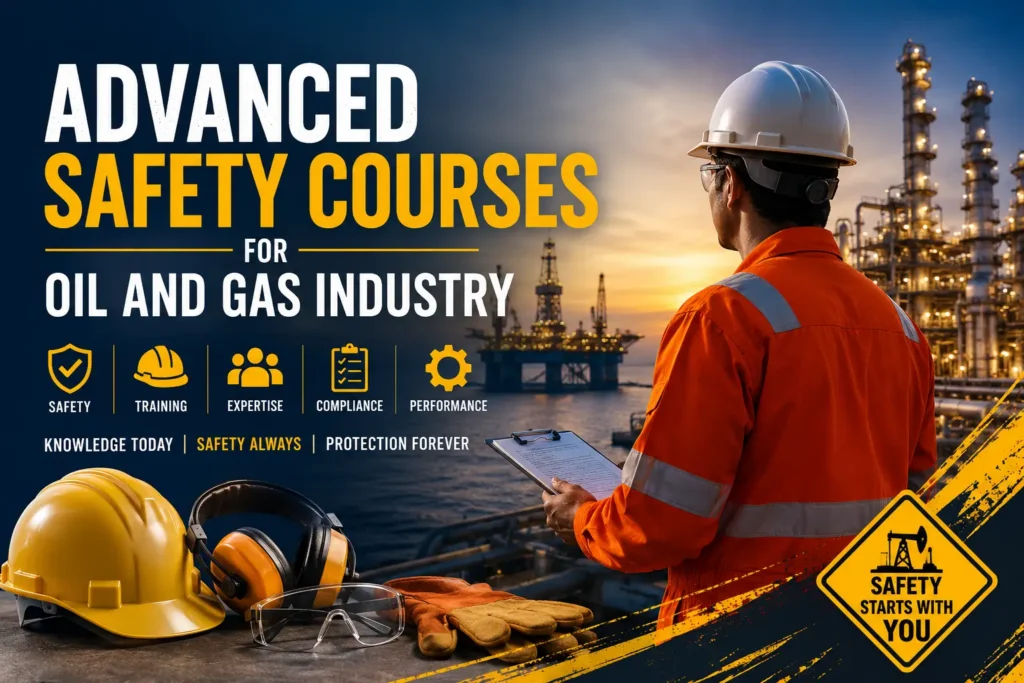
Advanced Safety Courses for Oil and Gas Industry
The oil and gas industry is one of the most dangerous working environments in the world. A single mistake can trigger explosions, toxic gas leaks, fires, environmental disasters, and fatal injuries. That is exactly why companies are no longer satisfied with basic safety knowledge. Employers now demand professionals who hold advanced safety certifications and specialized training designed specifically for high risk industrial operations.
Recent industry reports show that the global oil and gas sector is increasing investment in safety training, digital risk management, and competency development due to stricter regulations and the rising complexity of offshore and onshore operations. Safety professionals with internationally recognized certifications are now getting better salaries, faster promotions, and higher chances of landing Gulf jobs.
Before diving into the detailed article, let’s organize the structure clearly.
Why Safety Training Is Critical in the Oil and Gas Sector
The oil and gas industry operates like a giant machine filled with pressure, heat, chemicals, flammable gases, heavy equipment, and hazardous processes. One small failure can create a chain reaction that affects hundreds of workers and millions of dollars in assets. Unlike many other industries, workers here often operate in remote offshore rigs, desert drilling locations, refineries, pipelines, and confined processing plants where emergency response can be difficult. This is why safety training is not just a legal requirement. It is a survival tool.
Think about it this way. Driving a car on an empty road is easy. Driving through a storm on a mountain road demands experience, awareness, and advanced skills. Oil and gas operations are exactly like that dangerous mountain road. Workers need specialized knowledge to identify hazards before they turn into disasters. Companies now prefer professionals who can manage operational risk, conduct investigations, implement permit to work systems, and handle emergency situations confidently.
The industry has also changed dramatically in recent years. Automation, digital monitoring systems, stricter environmental laws, and global safety standards have increased the need for highly trained safety professionals. Major companies are investing heavily in workforce competency because accidents damage reputation, delay production, and lead to massive legal penalties. This growing focus has created huge opportunities for people holding advanced safety certifications.
Major Hazards in Oil and Gas Operations
Oil and gas sites contain multiple hazards working together at the same time. Workers may face toxic gas exposure, explosions, fires, high pressure systems, working at height risks, confined spaces, heavy lifting operations, and electrical hazards during a single shift. Hydrogen sulfide gas, commonly called H2S, is one of the deadliest threats because it can kill workers within minutes if exposure levels become high.
Mechanical failures are another serious concern. A damaged valve, corroded pipeline, or failed pressure system can cause catastrophic accidents. Offshore platforms add even more danger because evacuation during storms or emergencies becomes extremely difficult. Workers must know emergency escape procedures, rescue systems, and survival techniques before they are allowed to work offshore.
Human error also plays a major role in industrial accidents. Poor communication, lack of competency, rushing work, or ignoring procedures often lead to incidents. Advanced safety courses help workers develop hazard recognition skills and safe decision making abilities under pressure. That knowledge can literally save lives.
Rising Demand for Certified Safety Professionals
Oil and gas companies are competing for qualified safety personnel because regulations and client requirements are becoming stricter worldwide. Employers now ask for certifications like NEBOSH Oil and Gas, BOSIET, IOSH, OSHA, and H2S Training during recruitment. Gulf countries especially value internationally recognized qualifications because major projects involve multinational contractors working under global safety standards.
Safety professionals with advanced training are no longer limited to one role. They can work as HSE Officers, Safety Supervisors, Risk Assessors, Permit Coordinators, Incident Investigators, Offshore Safety Advisors, or Process Safety Specialists. The industry rewards competency because experienced safety professionals help companies avoid accidents and financial losses.
Recruiters also prefer candidates who combine theoretical knowledge with practical certifications. Someone holding only a general safety qualification may struggle against candidates with specialized oil and gas training. Advanced certifications act like powerful upgrades on a resume, making candidates stand out immediately.
What Makes an Advanced Safety Course Valuable
Not all safety courses carry the same weight in the industry. Some certifications are globally respected because they focus on practical hazard management, regulatory compliance, and real life industrial applications. A valuable course should prepare workers for actual field conditions instead of just teaching textbook theory.
The best oil and gas safety courses include practical scenarios, emergency response exercises, risk assessment methods, accident investigation techniques, and operational safety systems. Employers look for training programs that improve workplace performance rather than simply providing certificates. That is why internationally accredited programs are highly preferred.
International Recognition
International recognition matters because oil and gas companies operate globally. A certification accepted in the United Kingdom, UAE, Saudi Arabia, Qatar, and other industrial regions gives workers better mobility and career flexibility. Certifications from recognized organizations such as NEBOSH, IOSH, and OSHA are trusted because they follow globally accepted safety standards.
A worker holding internationally recognized qualifications can apply for offshore jobs, refinery projects, pipeline operations, and shutdown maintenance activities in multiple countries. This opens doors to higher salaries and long term career growth opportunities.
Practical Industry Applications
Employers do not want workers who only memorize definitions. They need professionals capable of handling emergencies, implementing safety systems, and reducing workplace risks. Advanced safety courses teach practical applications such as gas testing, emergency evacuation, permit to work systems, lockout tagout procedures, and process safety management.
Practical training builds confidence. Workers become capable of identifying unsafe conditions quickly and responding effectively during emergencies. That ability becomes extremely valuable during shutdowns, maintenance activities, and high risk operational tasks.
NEBOSH International Technical Certificate in Oil and Gas Operational Safety
The NEBOSH International Technical Certificate in Oil and Gas Operational Safety is one of the most respected qualifications in the industry. This course is specifically designed for professionals working in drilling, extraction, refining, and hydrocarbon processing environments. It focuses on operational hazards and the control measures needed to prevent catastrophic accidents.
The course covers topics such as hydrocarbon process safety, fire protection systems, permit to work systems, marine transport safety, contractor management, and emergency response planning. Students learn how to identify process hazards and implement effective safety controls within oil and gas facilities.
One reason this certification is highly respected is because it combines international safety principles with real industry applications. Employers recognize it as proof that a worker understands operational risk management in hazardous environments. Many Gulf recruiters list this qualification as a preferred requirement during hiring.
Course Overview
The NEBOSH Oil and Gas course is structured to provide practical knowledge that directly applies to industrial operations. It teaches students about risk reduction strategies, accident prevention systems, and operational control measures used in refineries and offshore installations.
Candidates also study lessons learned from major industrial disasters. Analyzing real incidents helps workers understand how small failures can escalate into catastrophic events. This approach improves hazard awareness and encourages proactive safety management.
Career Benefits
Holding a NEBOSH Oil and Gas certificate can significantly improve career opportunities. Safety professionals often use it to qualify for Gulf jobs, offshore projects, and refinery shutdown assignments. Many employers offer higher salaries to candidates with specialized operational safety qualifications.
The certification also strengthens professional credibility. Workers gain confidence because they understand how industrial safety systems function in real operations. That confidence often leads to leadership roles and supervisory responsibilities.
OSHA Oil and Gas Safety Courses
OSHA courses remain popular worldwide because they focus heavily on workplace hazard control and regulatory compliance. Oil and gas safety training under OSHA standards helps workers understand how to manage industrial risks using structured safety systems and preventive controls.
These programs cover topics like electrical safety, confined spaces, hazard communication, personal protective equipment, fall protection, and emergency procedures. OSHA training is especially useful for workers involved in construction, maintenance, and plant operations.
Key Topics Covered
OSHA oil and gas programs usually include detailed lessons on workplace inspections, incident prevention, chemical hazards, and machinery safety. Workers learn how to recognize unsafe conditions before they lead to injuries or equipment damage.
Emergency response planning is another important part of OSHA training. Employees are taught evacuation procedures, fire response techniques, and hazard reporting systems. These skills become critical during industrial emergencies where fast action can save lives.
Best Candidates for OSHA Training
OSHA courses are suitable for safety officers, supervisors, technicians, maintenance personnel, and construction workers involved in industrial operations. Freshers entering the industry can also benefit because OSHA training provides a strong foundation in workplace safety principles.
Employers value OSHA certifications because they demonstrate commitment to safe work practices. Workers with OSHA training often adapt faster to industrial environments and understand compliance requirements more effectively.
IOSH Managing Safely for Oil and Gas
The IOSH Managing Safely course is designed for managers and supervisors responsible for workplace safety. In oil and gas environments, leadership plays a critical role because supervisors directly influence worker behavior and operational discipline.
This program focuses on hazard identification, risk assessment, accident investigation, and performance monitoring. Managers learn how to create a positive safety culture where workers actively participate in hazard reporting and safe work practices.
One of the strongest benefits of IOSH training is its simplicity. The course explains complex safety concepts in a practical and easy to understand manner. Supervisors gain tools that help them manage safety responsibilities effectively without becoming overwhelmed by technical language.
H2S Safety Training and Certification
Hydrogen sulfide gas is one of the deadliest hazards in oil and gas operations. It is colorless, highly toxic, and capable of causing fatal exposure within minutes. That is why H2S training is mandatory for workers operating in drilling sites, refineries, and confined processing areas.
H2S courses teach workers how to detect gas exposure, wear breathing apparatus, use gas monitors, and respond during emergencies. Participants also learn evacuation procedures and rescue techniques for toxic gas incidents.
Why H2S Training Is Essential
Many workers underestimate gas hazards because toxic gases are often invisible. H2S can paralyze the sense of smell at high concentrations, making it even more dangerous. Proper training helps workers understand the seriousness of exposure risks and the importance of monitoring systems.
Employers prioritize H2S certification because it directly impacts worker survival during emergencies. Workers trained in gas safety respond faster and follow emergency procedures more effectively.
Offshore Safety Courses
Offshore work environments present unique challenges. Workers live and operate on isolated platforms surrounded by water, unpredictable weather, and hazardous equipment. Offshore safety training prepares personnel for emergency situations such as helicopter crashes, fires, evacuations, and sea survival.
BOSIET Certification
BOSIET stands for Basic Offshore Safety Induction and Emergency Training. It is one of the most recognized offshore certifications worldwide. Workers learn firefighting techniques, sea survival skills, helicopter safety, and emergency evacuation procedures.
BOSIET training includes practical exercises conducted in controlled environments. Participants experience simulated emergencies that prepare them for real offshore situations. This practical approach builds confidence and improves emergency readiness.
HUET Training
Helicopter Underwater Escape Training, commonly called HUET, teaches workers how to escape from submerged helicopters during offshore transport accidents. It sounds intense because it is. Participants practice underwater escape procedures while wearing survival equipment.
The training may feel challenging at first, but it prepares workers for one of the most dangerous offshore scenarios. Employers require HUET because offshore transportation heavily relies on helicopters.
Process Safety Management Courses
Process safety focuses on preventing catastrophic incidents involving chemicals, pressure systems, and hydrocarbon processes. Unlike traditional workplace safety, process safety deals with large scale industrial hazards capable of causing explosions, environmental disasters, and multiple fatalities.
Courses in process safety management teach hazard analysis, safety integrity systems, operational controls, and emergency preparedness. Workers learn how to manage complex industrial systems safely and prevent process failures.
Process safety specialists are highly valued because they help organizations reduce major accident risks. Refineries, petrochemical plants, and gas processing facilities heavily depend on process safety management systems to maintain safe operations.
Confined Space Entry Training
Confined spaces are dangerous because they may contain toxic gases, oxygen deficiency, engulfment hazards, or limited escape routes. Oil and gas workers frequently enter tanks, vessels, pipelines, and storage areas during maintenance operations.
Confined space training teaches atmospheric testing, ventilation methods, rescue planning, and permit requirements. Workers also learn communication procedures and emergency response techniques.
A confined space can appear harmless from the outside but become deadly within seconds. Proper training helps workers understand hidden hazards and follow safe entry procedures strictly.
Fire and Explosion Safety Courses
Fire hazards are everywhere in oil and gas operations because flammable materials are constantly present. Fire safety training teaches workers how to identify ignition sources, use firefighting equipment, and respond during emergencies.
Explosion prevention is another critical topic. Workers learn about static electricity, vapor cloud explosions, and ignition control measures. Understanding these risks helps reduce the likelihood of catastrophic industrial accidents.
Practical firefighting exercises are especially valuable because they improve reaction speed during emergencies. Workers become familiar with extinguishers, fire suppression systems, and emergency alarms.
Incident Investigation and Root Cause Analysis
Every accident tells a story. Incident investigation courses teach safety professionals how to uncover the real causes behind workplace incidents instead of blaming workers superficially.
Students learn interviewing techniques, evidence collection methods, and root cause analysis systems. Proper investigations help organizations prevent repeated accidents by correcting underlying failures.
Companies value professionals skilled in investigation because effective analysis improves operational safety and strengthens organizational learning.
Risk Assessment and HAZOP Training
Risk assessment forms the backbone of industrial safety management. Workers learn how to identify hazards, evaluate risk severity, and implement control measures before operations begin.
HAZOP, or Hazard and Operability Study, is widely used in oil and gas industries to analyze process systems systematically. Professionals trained in HAZOP can identify operational deviations that may lead to accidents.
This training improves analytical thinking and helps workers understand complex industrial processes more deeply.
Environmental and Chemical Safety Programs
Modern oil and gas companies face increasing pressure to protect the environment. Environmental safety courses focus on pollution prevention, waste management, chemical handling, and spill response systems.
Chemical safety training teaches workers about hazardous substances, exposure limits, storage requirements, and emergency controls. This knowledge protects both employees and surrounding communities.
Environmental compliance has become a major business priority because industrial accidents can severely damage company reputation and finances.
Best Countries for Oil and Gas Safety Jobs
Countries such as the UAE, Saudi Arabia, Qatar, Kuwait, Canada, Australia, and Norway continue to offer strong opportunities for qualified safety professionals. Gulf countries remain especially attractive because of ongoing refinery expansions, pipeline projects, and offshore developments.
Employers in these regions prefer internationally certified professionals who understand operational safety systems and global standards. Advanced certifications significantly improve hiring chances for overseas positions.
Salary Expectations After Advanced Safety Certifications
Salary levels vary depending on experience, certification level, and work location. Entry level safety officers may start with moderate salaries, while experienced offshore safety advisors and process safety specialists can earn significantly higher packages.
Workers holding certifications like NEBOSH Oil and Gas, BOSIET, and H2S training often receive better offers because employers recognize the value of specialized competency.
International assignments usually include additional benefits such as accommodation, transportation, food allowances, and rotational leave schedules.
How to Choose the Right Safety Course
Choosing the right course depends on career goals and industry focus. Workers targeting offshore careers should prioritize BOSIET and HUET training. Those interested in refinery or process plant operations may benefit more from process safety and NEBOSH Oil and Gas certifications.
It is also important to verify accreditation before enrolling in any program. Recognized certifications provide stronger career value and better employer acceptance.
Practical training quality matters just as much as certification reputation. Courses with hands on exercises and real industrial case studies offer stronger learning outcomes.
Online vs Classroom Oil and Gas Safety Training
Online learning has become increasingly popular because it offers flexibility and lower costs. Many theoretical safety courses can now be completed remotely using digital platforms.
Classroom training still remains essential for practical courses such as firefighting, HUET, and confined space rescue. Hands on exercises provide real experience that online simulations cannot fully replace.
The best approach often combines both methods. Workers can complete theory modules online while attending practical sessions physically.
Conclusion
Advanced safety courses have become essential for anyone serious about building a successful career in the oil and gas industry. Basic safety knowledge is no longer enough in an environment filled with high pressure systems, toxic gases, offshore hazards, and complex industrial operations. Employers want professionals who can identify risks, manage emergencies, and protect both people and assets effectively.
Certifications such as NEBOSH Oil and Gas, OSHA, IOSH, BOSIET, HUET, and H2S Training significantly improve career opportunities and earning potential. They also provide practical knowledge that helps workers stay safe in dangerous environments. In many ways, these certifications act like armor for workers entering one of the world’s toughest industries.
The oil and gas sector will continue evolving with new technologies, stricter regulations, and changing energy demands. Professionals who invest in advanced safety education today will position themselves strongly for future opportunities. Safety is no longer just a department in the industry. It has become the foundation that keeps the entire operation running successfully.
IOSH or NEBOSH, Which Has Better Job Scope?
Best Way to Apply for Safety Jobs Abroad in 2026
Freshers Safety Salary in Gulf, What You Can Expect
Safety Engineer vs Safety Officer Salary, Full Comparison
How to Increase Salary as a Safety Officer in 2026
FAQs
1. Which safety course is best for oil and gas jobs?
The NEBOSH International Technical Certificate in Oil and Gas Operational Safety is considered one of the best certifications for oil and gas careers because it focuses specifically on operational hazards and process safety.
2. Is BOSIET mandatory for offshore jobs?
Yes, most offshore companies require BOSIET certification before allowing workers to travel and work on offshore platforms.
3. Can freshers join oil and gas safety courses?
Yes, freshers can join many courses such as OSHA, IOSH, and H2S training. These certifications help beginners enter the industry with better knowledge and employability.
4. Which country offers the highest salary for safety officers in oil and gas?
Countries like Saudi Arabia, UAE, Qatar, Norway, and Canada often offer attractive salary packages for experienced safety professionals.
5. Are online safety courses accepted in the oil and gas industry?
Yes, many theoretical courses completed online are accepted, but practical certifications like BOSIET, HUET, and firefighting usually require physical attendance and hands on assessments.
