 Skip to content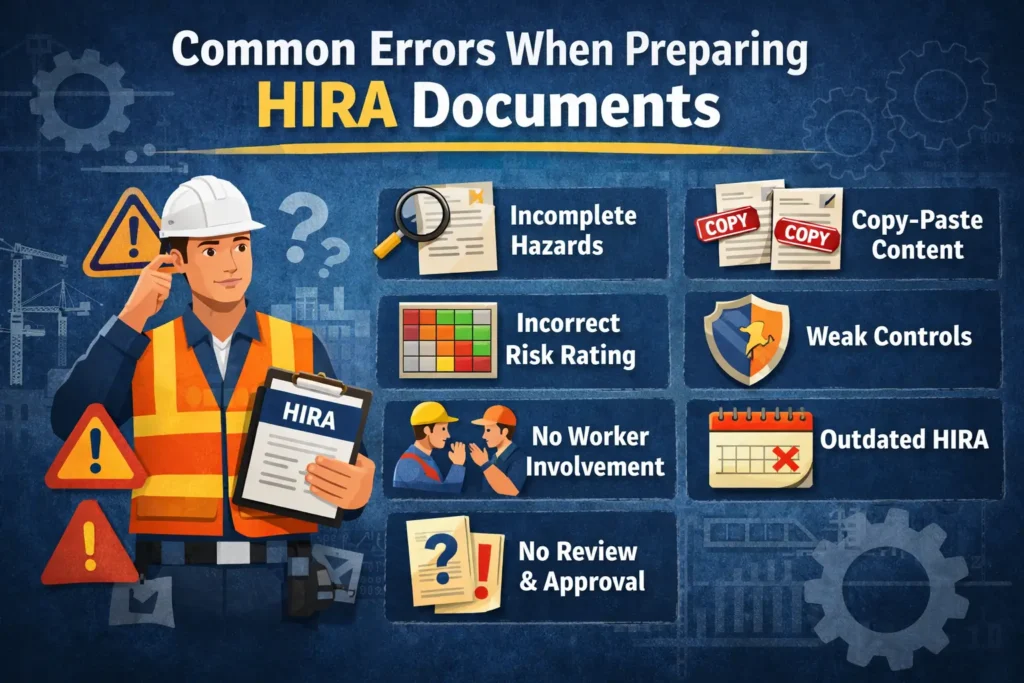
Common Errors When Preparing HIRA Documents (Avoid These Mistakes)
What is HIRA and Why It Matters
HIRA (Hazard Identification and Risk Assessment) is one of the most important tools in workplace safety. It is used to identify hazards, assess risks, and implement control measures before starting any activity. In simple words, HIRA helps answer one critical question, “What can go wrong, and how do we prevent it?”
It is widely used in construction, oil and gas, manufacturing, and other high-risk industries. A well-prepared HIRA document acts like a safety blueprint, guiding workers and supervisors to perform tasks safely.
Importance in Workplace Safety
Without a proper HIRA, work becomes unpredictable. Hazards remain unidentified, risks are underestimated, and control measures are either missing or ineffective.
A strong HIRA can prevent accidents, injuries, and even fatalities. But a poorly prepared HIRA can give a false sense of safety, which is even more dangerous.
Why HIRA Documents Often Fail
The Gap Between Theory and Practice
Many HIRA documents look perfect on paper but fail in real situations. Why? Because they are often prepared without understanding actual site conditions.
Safety is not just about documentation, it is about implementation. When HIRA is treated as a formality rather than a practical tool, errors become inevitable.
Error 1: Incomplete Hazard Identification
Missing Real Site Risks
One of the most common mistakes is missing key hazards. This happens when HIRA is prepared without proper site inspection.
For example, ignoring underground utilities in excavation work or overlooking weather conditions in lifting operations can lead to serious incidents.
Error 2: Copy-Paste HIRA (Generic Documents)
Lack of Site-Specific Details
Many professionals use copy-paste HIRA documents from previous projects. While this saves time, it creates a major risk.
Every site is different. Using generic HIRA means ignoring unique hazards and conditions, making the document ineffective.
Error 3: Poor Risk Evaluation
Incorrect Risk Rating
Risk evaluation must consider both likelihood and severity. Many HIRA documents either underestimate or overestimate risks.
Incorrect risk ratings lead to inappropriate control measures, increasing the chances of accidents.
Error 4: Weak Control Measures
Not Following Hierarchy of Control
Control measures should follow the Hierarchy of Control, starting from elimination to PPE.
A common mistake is relying only on PPE instead of implementing stronger controls like engineering solutions.
Error 5: Ignoring Human Factors
Behavior and Unsafe Acts
Human behavior plays a major role in accidents. Many HIRA documents focus only on physical hazards and ignore unsafe acts.
Workers may take shortcuts, ignore PPE, or misuse equipment. These factors must be included in HIRA.
Error 6: No Worker Involvement
Lack of Practical Input
Workers are the ones performing tasks, yet they are often not involved in HIRA preparation.
Their practical experience can provide valuable insights into real risks.
Error 7: Outdated HIRA Documents
Not Updating with Site Changes
Construction sites are dynamic. Conditions change frequently. Using outdated HIRA documents can lead to incorrect risk assessment.
Regular updates are essential.
Error 8: Overcomplicated Language
Workers Cannot Understand
HIRA documents are often written in complex language. Workers may not understand technical terms.
Simple and clear language improves effectiveness.
Error 9: No Link with Permit to Work
Poor Integration
HIRA should be linked with permit systems. Without this integration, safety controls may not be properly enforced.
Error 10: Lack of Review and Approval
Missing Authorization
HIRA documents must be reviewed and approved by competent authorities. Skipping this step reduces credibility.
Error 11: Ignoring Environmental Conditions
Weather and Site Changes
Weather conditions like rain, wind, and temperature can affect safety. Ignoring these factors is a major mistake.
Error 12: Poor Documentation Format
Confusing Layout
A poorly structured HIRA document is difficult to understand and use. Clear format and layout are essential.
Real Example of a Failed HIRA
What Went Wrong
In one case, a lifting operation HIRA did not consider wind conditions. During the lift, strong winds caused the load to swing, leading to an accident.
This shows how missing a single factor can lead to serious consequences.
Comparison Table: Good vs Bad HIRA
| Criteria | Good HIRA | Bad HIRA |
|---|---|---|
| Hazard Identification | Detailed | Incomplete |
| Risk Evaluation | Accurate | Incorrect |
| Control Measures | Strong | Weak |
| Language | Simple | Complex |
| Updates | Regular | Outdated |
How to Prepare an Effective HIRA
Practical Tips
- Conduct site inspection
- Involve workers
- Use simple language
- Follow hierarchy of control
- Update regularly
Role of Safety Officer in HIRA
Monitoring and Implementation
Safety officers ensure that HIRA is properly prepared and implemented. They monitor compliance and update documents as needed.
Key Takeaways
- HIRA is critical for safety
- Common errors reduce effectiveness
- Site-specific details are essential
- Regular updates are required
Conclusion
HIRA is not just a document, it is a life-saving tool. Avoiding common errors can significantly improve safety performance. A strong HIRA ensures that risks are controlled and workers are protected.
Risk Assessment for Excavation Activities (Complete Practical Safety Guide)
Risk Matrix Explained with Practical Examples
How to Perform Job Safety Analysis Step by Step
Step by Step Guide to Root Cause Analysis
Common Investigation Mistakes Safety Officers Make
FAQs
1. What is HIRA?
Hazard Identification and Risk Assessment.
2. Why do HIRA documents fail?
Due to poor hazard identification and generic content.
3. How can HIRA be improved?
By involving workers and updating regularly.
4. What is the biggest mistake in HIRA?
Copy-paste without site-specific details.
5. Who prepares HIRA?
Safety officers and supervisors.
