Site-Specific Risk Assessment: Why One Size Does Not Fit All
Learn why site-specific risk assessment is critical for workplace safety. Understand its importance, process, examples, and best practices for high-risk sites.
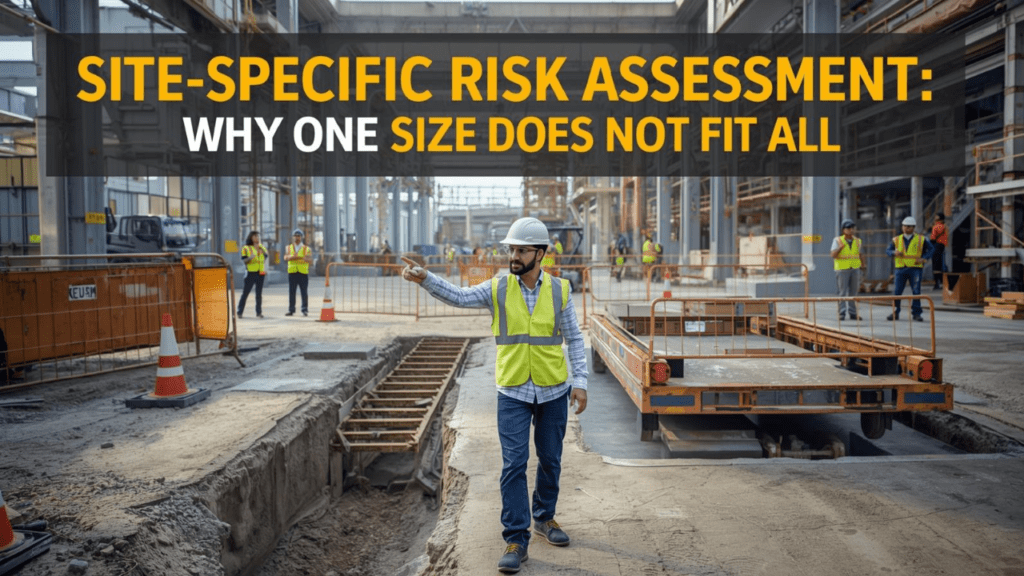
Risk assessment is a core requirement of any effective safety management system. However, one of the most common mistakes made by organizations is assuming that one generic risk assessment can be applied to all locations, projects, or work environments. In reality, every workplace is unique, and hazards vary significantly depending on location, activities, people, and conditions.
This is where site-specific risk assessment becomes essential. This article explains what site-specific risk assessment is, why a “one size fits all” approach fails, and how safety professionals can conduct effective, practical assessments tailored to each site.
What Is a Site-Specific Risk Assessment?
A site-specific risk assessment is a detailed evaluation of hazards and risks unique to a particular worksite. Unlike generic or corporate-level risk assessments, it considers actual site conditions, layout, activities, equipment, workforce, and environmental factors.
In simple terms, it answers the question:
“What risks exist at this site, right now, and how should they be controlled?”
Site-specific risk assessments are commonly used in construction projects, industrial plants, infrastructure works, oil and gas facilities, and maintenance shutdowns.
Why Generic Risk Assessments Are Not Enough
Many organizations rely on standard risk assessment templates that are copied and reused across multiple sites. While templates can provide a starting point, they often fail to address real-world conditions.
Generic risk assessments usually:
- Ignore site layout differences
- Overlook local environmental conditions
- Assume the same equipment and work methods
- Fail to consider workforce competency
- Miss interaction between simultaneous activities
As a result, hazards remain unidentified, and risks are underestimated.
Why One Size Does Not Fit All in Risk Assessment
Every site has its own combination of hazards. Even similar projects can present very different risk profiles.
Different Physical Environments
Two construction sites may involve the same type of work but be located in entirely different environments.
For example:
- One site may be in a congested urban area
- Another may be in a remote, open location
Traffic hazards, access routes, emergency response time, and public exposure risks will vary significantly.
Variations in Workforce
Workforce-related factors play a major role in risk levels, such as:
- Skill and experience of workers
- Language barriers
- Fatigue levels
- Contractor involvement
A site with experienced workers may have lower behavioral risks compared to a site with new or untrained workers.
Differences in Equipment and Tools
Equipment condition, capacity, and suitability can differ from site to site. Using the same risk assessment without verifying actual equipment on-site can lead to incorrect conclusions.
Changing Environmental Conditions
Weather, lighting, noise, and temperature affect risk levels. A generic assessment prepared in ideal conditions may be completely ineffective during adverse weather or night work.
Importance of Site-Specific Risk Assessment
Conducting site-specific risk assessments provides several critical benefits.
Improved Hazard Identification
By focusing on actual site conditions, safety officers can identify hazards that generic assessments miss, such as:
- Uneven ground
- Restricted access
- Overhead services
- Nearby operations
Accurate Risk Evaluation
Site-specific assessments allow realistic evaluation of likelihood and severity based on actual exposure and conditions.
Better Control Measures
Controls can be designed specifically for the site, making them more practical and effective.
Enhanced Worker Engagement
When workers see that assessments reflect real conditions, they are more likely to participate and follow controls.
Stronger Legal Compliance
Many safety regulations require risk assessments to be suitable and sufficient. Site-specific assessments help demonstrate due diligence.
When Is a Site-Specific Risk Assessment Required?
A site-specific risk assessment is required in situations such as:
- New project or site start-up
- Change in work location
- Introduction of new equipment or processes
- Non-routine or high-risk activities
- Change in workforce or contractors
- After incidents or near misses
In many industries, site-specific assessments are mandatory before work begins.
Key Elements of a Site-Specific Risk Assessment
An effective site-specific risk assessment includes the following elements.
Site Description
This includes details such as:
- Location
- Layout and access points
- Nearby activities
- Emergency arrangements
A clear understanding of the site is essential.
Task and Activity Analysis
All activities to be performed on-site should be identified, including routine and non-routine tasks.
Hazard Identification
Hazards are identified by considering:
- Physical conditions
- Equipment and machinery
- Materials and substances
- Environmental factors
- Human behavior
Hazards must reflect actual site conditions, not assumptions.
Risk Evaluation
Each hazard is evaluated based on:
- Likelihood of occurrence
- Severity of potential consequences
This helps prioritize actions.
Control Measures
Controls are selected based on the hierarchy of controls and must be feasible for the site.
Roles and Responsibilities
Clear assignment of responsibilities ensures accountability for implementing controls.
Step-by-Step Process for Site-Specific Risk Assessment
Step 1: Conduct a Site Visit
A physical walk-through of the site is essential. Desk-based assessments are not sufficient for site-specific risks.
Step 2: Involve the Right People
Include:
- Safety officers
- Supervisors
- Workers familiar with the site
- Contractors
Their input improves accuracy.
Step 3: Identify Site Hazards
Observe work areas, access routes, storage areas, and interaction between activities.
Step 4: Evaluate Risks
Assess likelihood and severity considering real site conditions, not ideal scenarios.
Step 5: Define Site-Specific Controls
Controls should address actual hazards, such as temporary barriers, traffic plans, or specific PPE.
Step 6: Communicate the Assessment
The assessment must be explained to all workers through inductions, toolbox talks, or pre-job briefings.
Step 7: Review and Update
Site-specific risk assessments must be reviewed regularly and whenever conditions change.
Examples of Site-Specific Risk Assessment
Example 1: Construction Project
Two construction projects involve similar structural work. One site is near a busy road, while the other is in an isolated area.
- Urban site risks: traffic interaction, public safety, noise complaints
- Remote site risks: delayed emergency response, limited communication
Each site requires different controls.
Example 2: Maintenance Work in a Plant
Maintenance work carried out during normal operations presents different risks compared to a planned shutdown.
A site-specific assessment identifies interaction risks with running equipment.
Example 3: Confined Space Entry
Confined spaces vary widely in size, access, atmosphere, and rescue arrangements. A generic confined space assessment may miss critical site hazards.
Role of Safety Officers in Site-Specific Risk Assessment
Safety officers play a central role by:
- Leading the assessment process
- Ensuring site conditions are accurately reflected
- Challenging generic assumptions
- Verifying implementation of controls
- Monitoring ongoing site changes
Their presence on-site is critical to effectiveness.
Common Mistakes in Site-Specific Risk Assessment
Despite good intentions, mistakes still occur.
Copy-Paste Assessments
Using assessments from previous projects without modification is one of the biggest failures.
Lack of Site Involvement
Assessments prepared without site visits or worker input often miss key hazards.
Failure to Update
Site conditions change frequently, especially in construction and industrial projects.
Overly Complex Documents
Overly technical assessments may not be understood by workers.
Best Practices for Effective Site-Specific Risk Assessment
To ensure effectiveness:
- Always conduct on-site assessments
- Use simple, clear language
- Focus on realistic worst-case scenarios
- Involve workers and supervisors
- Review assessments regularly
- Link assessments to permits and work planning
Practicality is more important than paperwork.
Relationship with Other Safety Systems
Site-specific risk assessments support and integrate with:
- Permit-to-work systems
- Job safety analysis
- Method statements
- Emergency response plans
- Safety inductions
Together, these systems form a strong safety framework.
Legal and Compliance Importance
Most occupational safety laws require risk assessments to be suitable and sufficient. Generic assessments may not meet this requirement if they do not reflect site conditions.
Site-specific risk assessments demonstrate:
- Due diligence
- Proactive risk management
- Commitment to worker safety
They are often reviewed during audits and investigations.
Conclusion
Every workplace is unique, and hazards vary from site to site. Applying a generic risk assessment without considering actual conditions creates gaps that can lead to accidents. Site-specific risk assessment ensures that hazards are identified accurately, risks are evaluated realistically, and control measures are practical and effective. By recognizing that one size does not fit all, organizations can significantly improve safety performance and protect workers in complex, high-risk environments.
For checklist and templates visit The HSE Tools.
Pre-Job Risk Assessment for High-Risk Activities
Risk Rating Systems Explained for Industrial Projects
Hazard Identification Methods Used by Safety Officers
Permit to Work Template (Hot Work, Confined Space, etc.)
Incident Investigation Report Template Free
Frequently Asked Questions (FAQs)
What is the main purpose of a site-specific risk assessment?
Its purpose is to identify and control hazards unique to a particular site and set of conditions.
Can a generic risk assessment be used at multiple sites?
Generic assessments can be used as a starting point, but they must be adapted to each site.
Who should conduct a site-specific risk assessment?
Safety officers lead the process, with input from supervisors, workers, and contractors.
How often should site-specific risk assessments be reviewed?
They should be reviewed whenever site conditions, activities, or personnel change.
Is site-specific risk assessment a legal requirement?
In most jurisdictions, risk assessments must be suitable and sufficient, which often requires a site-specific approach.
