 Skip to content
 Pre-Job Risk Assessment for High-Risk Activities
Learn how to conduct a pre-job risk assessment for high-risk activities. Step-by-step process, examples, responsibilities, and best practices explained.
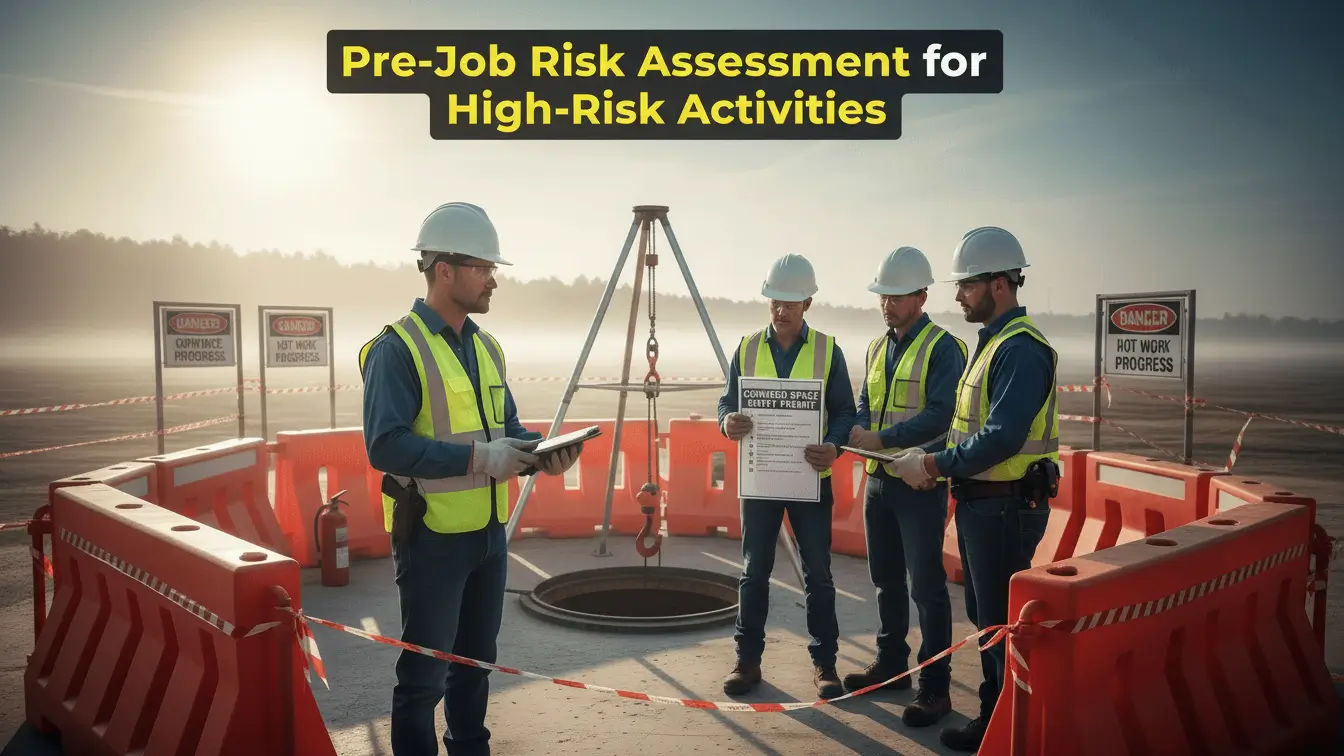
High-risk activities are a daily reality in industrial environments such as construction sites, oil and gas facilities, power plants, manufacturing units, and infrastructure projects. Tasks like confined space entry, hot work, lifting operations, electrical maintenance, and working at height carry a higher potential for serious injury or fatality if not properly controlled.
One of the most effective tools used by safety professionals to prevent accidents in such situations is the pre-job risk assessment. This article explains pre-job risk assessment for high-risk activities, why it is critical, how it is conducted, and how it helps organizations manage risks before work begins.
What Is a Pre-Job Risk Assessment?
A pre-job risk assessment is a systematic evaluation of hazards and risks conducted before starting a specific task or job. Unlike general risk assessments, it focuses on the exact activity, location, equipment, and people involved at that moment.
The goal is simple:
Identify what could go wrong before work starts and put controls in place to prevent it.
Pre-job risk assessments are especially important for non-routine and high-risk tasks where conditions can change rapidly.
What Are High-Risk Activities?
High-risk activities are tasks that have a greater likelihood of causing serious harm if control measures fail. These activities usually involve one or more of the following:
- Working at height
- Confined spaces
- Hazardous energy or electricity
- Heavy lifting and crane operations
- Hot work (welding, cutting, grinding)
- Excavation and trenching
- Pressure systems
- Chemical handling
Because of the severity of potential outcomes, these tasks require stricter planning and supervision.
Why Pre-Job Risk Assessment Is Critical for High-Risk Activities
Many workplace accidents occur not because hazards were unknown, but because risks were not reassessed just before the job started. Pre-job risk assessments address this gap.
They help to:
- Identify task-specific hazards
- Address changing site conditions
- Ensure workers understand the risks
- Confirm control measures are in place
- Prevent unsafe assumptions
- Support permit-to-work systems
For high-risk activities, skipping a pre-job risk assessment can lead to catastrophic consequences.
Difference Between Pre-Job Risk Assessment and General Risk Assessment
A common misunderstanding is that a pre-job risk assessment replaces a general risk assessment. In reality, they serve different purposes.
- General risk assessment looks at overall workplace hazards
- Pre-job risk assessment focuses on the specific job at a specific time
Pre-job assessments are more detailed and practical, often conducted immediately before work begins.
When Is a Pre-Job Risk Assessment Required?
Pre-job risk assessments are required:
- Before starting any high-risk activity
- When work is non-routine or unusual
- When site conditions change
- When new equipment or workers are involved
- After an incident or near miss
- When permits are issued
Many organizations make pre-job risk assessments mandatory for all critical tasks.
Key Elements of a Pre-Job Risk Assessment
An effective pre-job risk assessment includes several essential elements.
Job Description
The job must be clearly defined, including:
- Scope of work
- Location
- Duration
- Sequence of activities
Clear understanding prevents assumptions and confusion.
Identification of Hazards
Hazards are identified for each step of the job. These may include:
- Physical hazards
- Electrical hazards
- Chemical hazards
- Mechanical hazards
- Environmental conditions
- Human factors
This step forms the foundation of the assessment.
Risk Evaluation
Each identified hazard is evaluated based on:
- Likelihood of occurrence
- Severity of potential outcome
This helps prioritize hazards that require immediate control.
Control Measures
Controls are selected using the hierarchy of controls:
- Elimination
- Substitution
- Engineering controls
- Administrative controls
- Personal protective equipment
Controls must be realistic and enforceable.
Communication and Approval
The assessment must be explained to all workers involved. Supervisors and safety officers review and approve it before work begins.
Step-by-Step Process for Pre-Job Risk Assessment
Step 1: Assemble the Job Team
All personnel involved in the task should participate, including:
- Supervisor
- Safety officer
- Workers performing the job
This ensures practical input and shared responsibility.
Step 2: Break the Job into Steps
The task is divided into logical steps. This helps identify hazards at each stage rather than looking at the job as a whole.
Step 3: Identify Hazards for Each Step
For every step, ask questions such as:
- What could go wrong?
- What could cause injury or damage?
- What conditions could change during work?
Workers’ experience is particularly valuable at this stage.
Step 4: Evaluate the Risks
Assess the likelihood and severity of each hazard. High-risk hazards must be clearly highlighted.
Step 5: Define Control Measures
Specify control measures for each hazard. Controls should be:
- Clearly described
- Practical to implement
- Assigned to responsible persons
Avoid generic controls such as “be careful.”
Step 6: Conduct Pre-Job Briefing
Before work starts, the assessment is discussed during a toolbox talk or pre-job briefing. Workers confirm their understanding and agreement.
Step 7: Monitor and Review During the Job
If conditions change, work must stop and the risk assessment must be reviewed.
Examples of Pre-Job Risk Assessment for High-Risk Activities
Example 1: Confined Space Entry
- Hazard: Oxygen deficiency
- Risk: Asphyxiation
- Controls: Gas testing, ventilation, standby person, permit system
Pre-job assessment ensures conditions are safe before entry.
Example 2: Hot Work
- Hazard: Fire or explosion
- Risk: Severe burns or property damage
- Controls: Hot work permit, fire watch, removal of flammable materials
Conditions are reassessed immediately before work.
Example 3: Lifting Operation
- Hazard: Load fall
- Risk: Fatal injury
- Controls: Lift plan, certified crane, trained rigger, exclusion zone
The pre-job assessment confirms readiness of equipment and personnel.
Roles and Responsibilities in Pre-Job Risk Assessment
Safety Officer
- Facilitate the assessment
- Ensure hazards are properly identified
- Verify control measures
- Stop work if risks are unacceptable
Supervisor
- Lead job planning
- Ensure workers follow controls
- Monitor conditions during work
Workers
- Participate actively
- Raise concerns
- Follow agreed safety measures
Shared responsibility improves effectiveness.
Common Mistakes in Pre-Job Risk Assessments
Despite their importance, pre-job risk assessments are sometimes treated as paperwork.
Common mistakes include:
- Copy-pasting old assessments
- Rushing the process
- Excluding workers
- Ignoring changing conditions
- Using vague control measures
Such practices reduce the value of the assessment.
Best Practices for Effective Pre-Job Risk Assessment
To improve quality and effectiveness:
- Conduct assessments at the job site
- Involve experienced workers
- Use clear and simple language
- Focus on worst-case scenarios
- Review assessments when conditions change
- Encourage stop-work authority
A good assessment is practical, not just compliant.
To help you carry out pre-job risk assessments for high-risk activities confidently, download an editable pre-job risk assessment checklist and control templates.
Relationship with Permit-to-Work System
For high-risk activities, pre-job risk assessments are often linked to permits such as:
- Confined space permit
- Hot work permit
- Electrical work permit
- Work at height permit
The risk assessment supports the permit by confirming hazards and controls.
Legal and Compliance Importance
Most safety regulations require employers to:
- Identify hazards
- Assess risks
- Implement controls
Pre-job risk assessments provide documented evidence that risks were evaluated before starting high-risk work, which is crucial during audits and investigations.
Conclusion
Pre-job risk assessment is one of the most powerful tools for preventing accidents during high-risk activities. By identifying hazards, evaluating risks, and implementing controls before work begins, organizations can significantly reduce injuries, fatalities, and losses. When done properly, pre-job risk assessment for high-risk activities becomes a proactive safety practice rather than a routine formality. It protects workers, supports supervisors, and strengthens overall safety performance.
Risk Rating Systems Explained for Industrial Projects
Hazard Identification Methods Used by Safety Officers
Permit to Work Template (Hot Work, Confined Space, etc.)
Risk Assessment Template for Construction Projects
Daily Site Safety Report Template (Editable PDF/Excel)
Frequently Asked Questions (FAQs)
What is the purpose of a pre-job risk assessment?
Its purpose is to identify and control job-specific hazards before work starts, especially for high-risk activities.
Who should participate in a pre-job risk assessment?
Supervisors, safety officers, and workers involved in the task should all participate.
Is pre-job risk assessment mandatory?
For high-risk activities, it is often mandatory under company procedures and legal safety requirements.
How often should a pre-job risk assessment be reviewed?
It should be reviewed whenever site conditions, equipment, or work scope changes.
Can work continue if conditions change?
No. Work should stop, and the risk assessment must be updated before continuing.
